How Much of a CIM Can You Hand to AI?
Capital Markets



September, 2026
The direct answer, in numbers, from where investment banks and PE firms are actually landing in 2026.
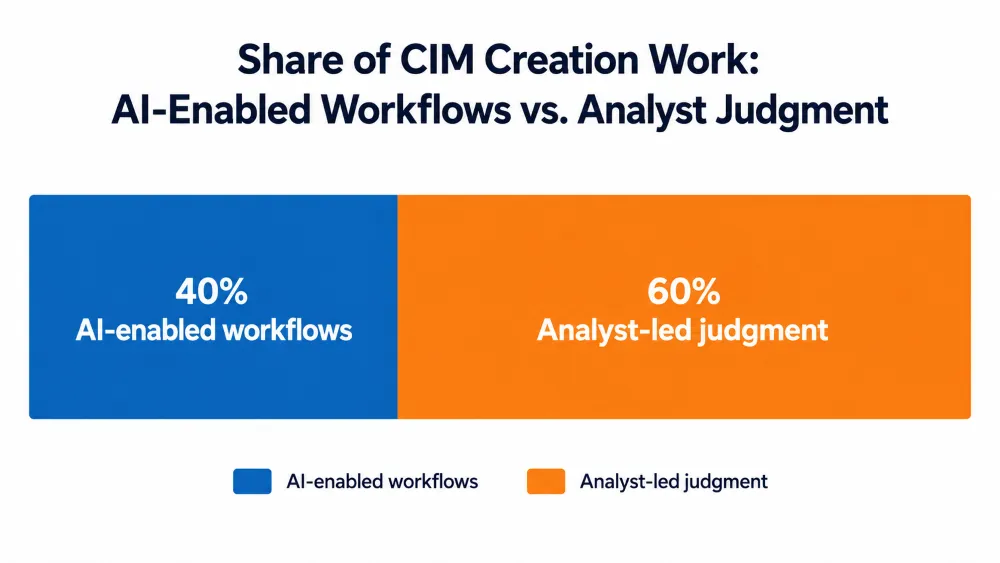
Short answer: today, close to 40% of the CIM creation process in terms of volume of work can be done by AI. The other 60% requires human judgment that must remain with the analyst. Here’s where that line sits and why.
Figure 1: Share Of CIM Creation Work Handled By AI-Enabled Workflows vs. Analyst Judgment, Based on Our Work with 500+ Investment Banks.
Source: SG Analytics
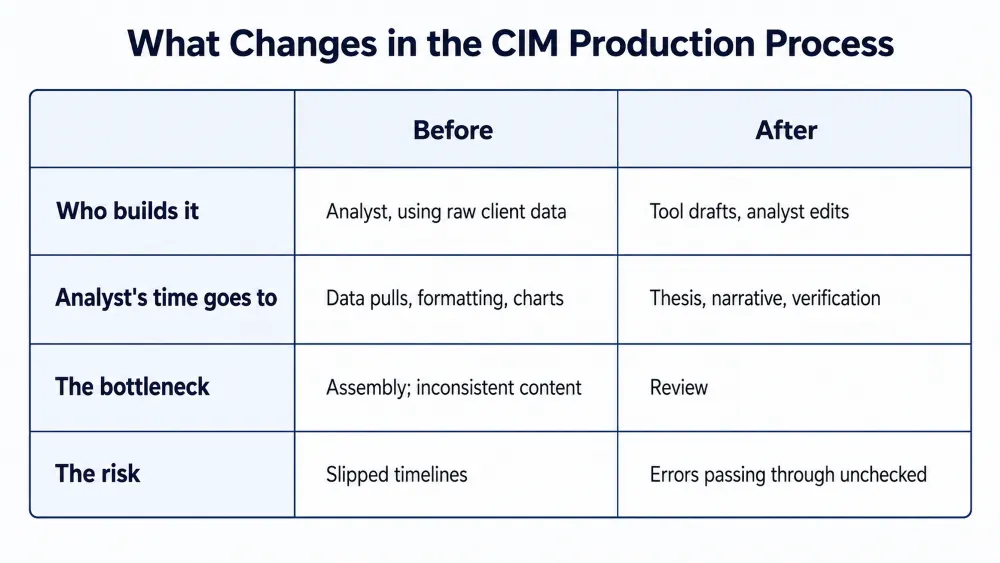
The 40% is almost entirely assembly work: company overview, products, and management sections built from client materials and the bank’s template, plus pulling and reconciling data from company websites, data rooms, filings, PitchBook, and Capital IQ. The 60% of CIM, including sections such as investment highlights and financial performance, is where analysts decide how the company should be positioned to buyers, and it’s where they concentrate roughly 90% of their thinking time, regardless of what tooling is in place.
Figure 2: Standard First-Draft Turnaround, Before vs. After AI-Assisted Drafting
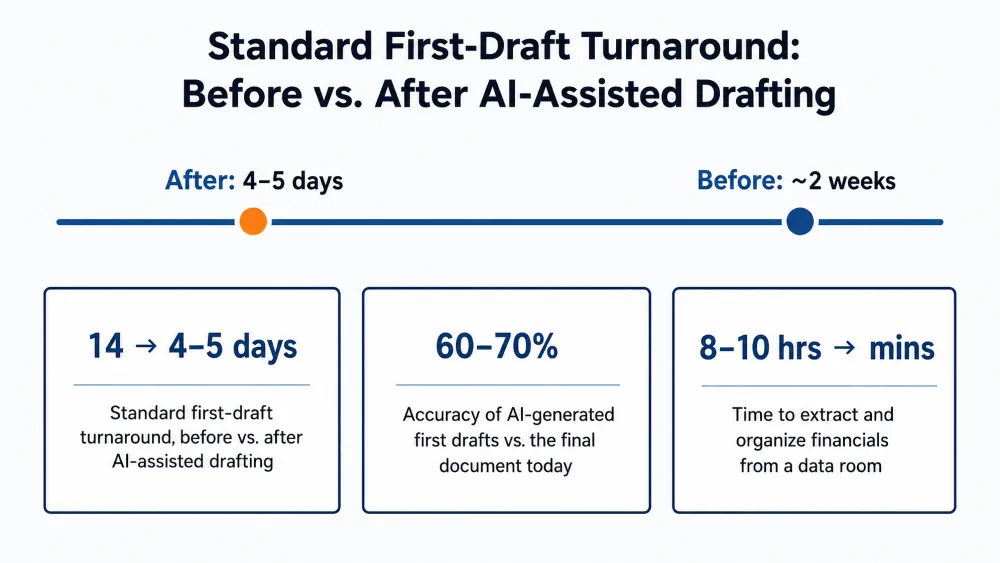
Figure 4: What Changes in the CIM Production Process
Where the Line Won’t Move
AI can’t decide the investment thesis, judge which points will land hardest with a buyer, or confirm a claim survives due diligence. That matters most in mid-market deals, where public information is thin, and the strongest selling points live in management conversations and operating data that a data room doesn’t capture. Continued training could push first-draft accuracy from today’s 60–70% to 90–95%. Still, analyst review remains part of the process, as the remaining gap is judgment, not a data problem that better models will eventually solve.
This is not only about operational efficiency but also the impact on the incoming generation of bankers. Junior bankers still pull 80–100-hour weeks during peak dealmaking, and tools like Rogo have shown individual analysts saving roughly 60 hours of grunt work in a single week. But recruiters and senior bankers are already warning that automating the work junior staff used to learn from carries its own risk. DHR Global’s Jeanne Branthover has stated plainly that skipping foundational work “is going to be detrimental to the young bankers.” Therefore, it is important to understand how the next generation of analysts is trained to handle the 60% that must remain human.
Read more: US VC Midyear Outlook 2026: Liquidity and Portfolio Quality Define the Recovery
For Context: AI Adoption Across Financial Services
The CIM-specific numbers are part of a much bigger shift. AI adoption in the financial services industry has accelerated sharply, and in investment banking in particular, that shift can be seen across the entire deal process, including origination, due diligence, pitchbooks, financial modeling, and compliance.
Cambridge Judge Business School’s 2026 report on AI in financial services found that 81% of firms have adopted AI at some level, with 40% describing their adoption as advanced. Spending reflects this as JPMorgan invests roughly $2 billion a year in AI, and a first-quarter CIO survey put average projected AI spending across the sector at $177 million per bank over the following 12 months. Deloitte’s 2025 GenAI in M&A study put the share of organizations using generative AI in their M&A workflow at 86%, with 65% having integrated it in the past year and 83% of adopters committing $1 million or more to it.
The adoption is mostly earlier in the deal where CIM production takes place. Accenture found that 46% of organizations are investing in generative AI for pre-deal activity in 2026, compared with just 27% who are doing it for post-deal activity. Deloitte’s analysis shows the same pattern, with 40% of GenAI use falling under strategy and market assessment, 35% under target screening and due diligence, and roughly 32% each under valuation, deal execution, and post-deal integration.
Deloitte projects the IB division (equity and debt issuance plus M&A advisory) will see the largest productivity gain of any IB business line:
Figure 4: Productivity Gains Per Full-Time Employee Across IB Business Lines
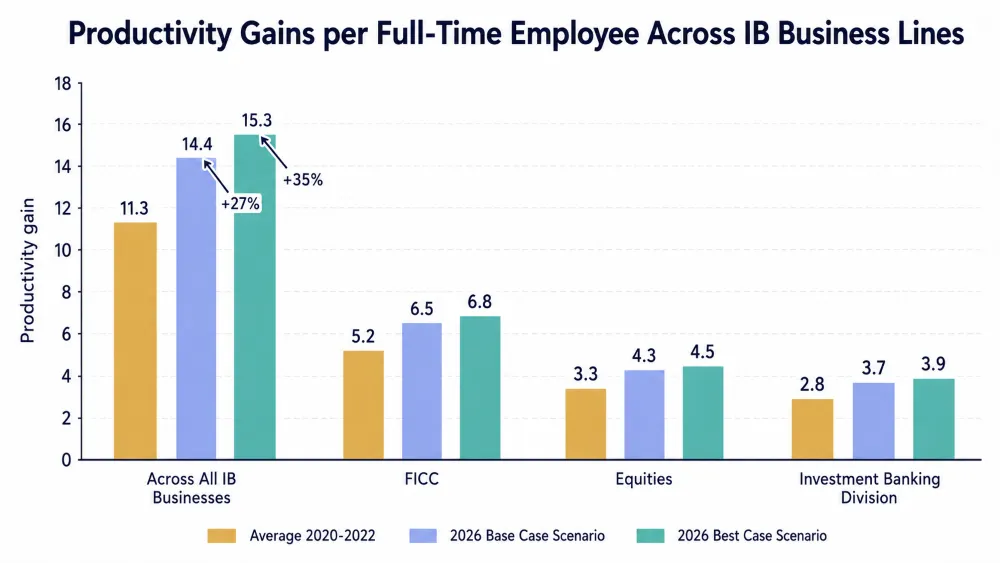
Source: Deloitte
The payoff of adopting AI is more than just reduced banker hours. McKinsey has found that generative AI not only shortens overall deal cycles by 10–30% but also trims costs by roughly 20%. Additionally, Accenture has found that firms that scale agentic AI into their core value levers see 1.7x higher projected profitability margins than those that don’t.
Read more: Physical AI and Robotics Shift Toward Commercial Deployment
What’s Actually Slowing Adoption
Investment firms primarily use AI in early, lower-risk deal activities because experienced bankers remain concerned about data security and the reliability of the output. This is evident from Deloitte’s survey, in which 67% of adopters cited data security as their top barrier, followed by data quality (65%), model reliability (64%), and ethical considerations (62%). Firms therefore generally use AI to support analysts, not replace them entirely, and avoid entering confidential deal information into unsecured general-purpose tools.
Large Banks Build, Smaller Firms Buy Expertise
The largest banks have built their own systems. For example, Goldman Sachs has extended its GS AI Assistant to more than 46,500 employees, and JPMorgan has over 230,000 employees using its internal LLM Suite. Mid-market and boutique firms more often buy tools built for banking workflows, since they don’t have the capital to stand up an internal AI platform, and keep their own attention on sector expertise, senior relationships, and execution. General-purpose tools have been a limiting factor for both tiers: Microsoft Copilot reports a 60–70% reduction in time to build pitch decks, but one European bank that rolled it out to a 42-person presentation team saw adoption sit at 8% after six weeks, with brand-compliance violations tripling.
The Buy Side is Moving Just as Fast
None of this is happening in isolation on the sell side. Buyers are moving in the same direction, as evident from PE and corporate development teams’ increased use of AI to triage incoming CIMs faster, with one CIM-review vendor claiming up to 85% less review time (a vendor figure, worth taking as directional rather than independently verified). In a typical mid-market process, initial CIM screening occurs within the first two to three weeks of a four-to-six-month timeline. Therefore, faster and more consistent sell-side drafting matters, in part, because buyers’ reading speed is getting faster too.
Read more: The Mid-Year AI Reset: 6 Patterns That Will Define H2 2026 for Enterprise Leaders
The Net Effect
Put together, AI-assisted production and analyst judgment are reducing the time usually taken to create the standard first draft from about two weeks to four to five days. The bottleneck has moved from assembly to review, which is a better problem to have, provided the review step is treated as seriously as the old drafting step was. Firms getting the most out of this keep analysts firmly in charge of the investment story, buyer positioning, and final sign-off, and use AI to clear the production work out from under them.
About SG Analytics
SG Analytics (SGA) is a global leader in data-driven research and analytics, empowering Fortune 500 clients across BFSI, Technology, Media & Entertainment, and Healthcare. A trusted partner for lower middle market investment banks and private equity firms, SGA provides offshore analysts with seamless deal life cycle support. Our integrated back-office research ecosystem, including database access, design support, domain experts, and tech-enabled automation, helps clients win more mandates and execute deals with precision.
Founded in 2007, SGA is a Great Place to Work® certified firm with 1,600+ employees across the U.S., the UK, Switzerland, Poland, and India. Recognized by Gartner, Everest Group, and ISG and featured in the Deloitte Technology Fast 50 India 2023 and Financial Times APAC 2024 High Growth Companies, we continue to set industry benchmarks in data excellence.
Related Tags
Author

Steve Salvius
Head of Investment Banking & Private Equity
