Intelligent Document Management Services
Optimize your corporate data ecosystem with SG Analytics (SGA)’s premier intelligent document management services engineered for modern, high-velocity operations. Our frameworks elevate enterprise document management by automating secure classification, indexing, and instant information retrieval to ensure absolute compliance, zero data latency, and seamless processing across your transactional infrastructure.
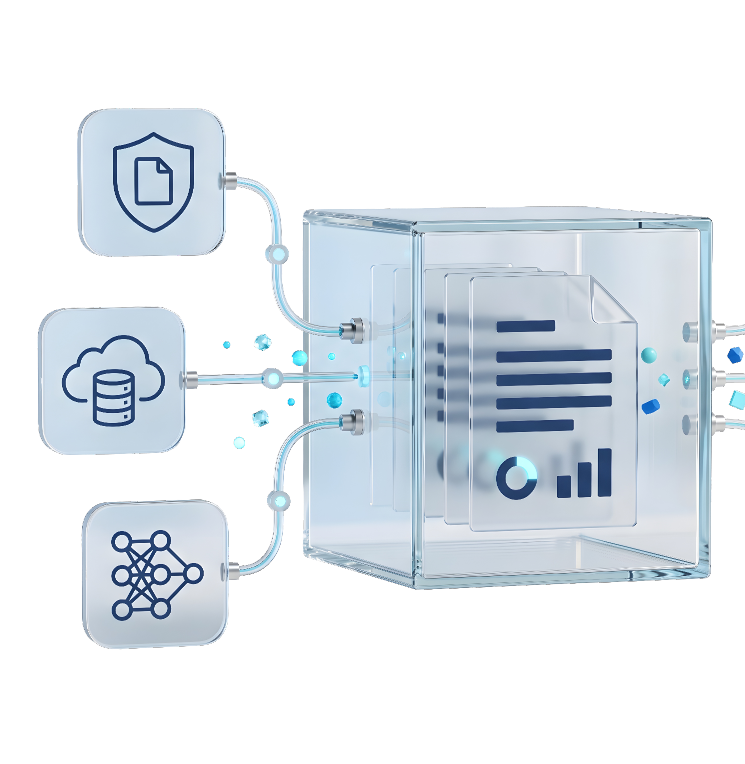
What Is Intelligent Document Management?

Comparison Dimension
Traditional Document Management
Intelligent Document Management
Primary Purpose
Passive file storage and basic retrieval requests
Complete workflow optimization via automated processing pipelines
Data Accessibility
Restrictive manual searches creating information delivery latency
Instant context-aware lookups through deep indexing layers
Classification
Slower human sorting prone to structural schema drift
Automated grouping utilizing linguistic and layout algorithms
Life Cycle Coverage
Fragmented steps isolated strictly to archival data storage
Comprehensive tracking from ingestion to target system loading
Compliance and Audit
Minimal file traceability requiring expensive manual auditing cycles
Permanent immutable tracking logs ensuring constant audit readiness
Operational Cost
High variable expenditures tied to compounding labor requirements
Optimized capital efficiency driven by autonomous machine scaling
Our Intelligent Document Management Capabilities
Multi-Source Document Collection
We facilitate automated asset extraction across multiple internal networks, regulatory nodes, and public file repositories. This systematic ingestion architecture establishes a constant flow of unstructured text directly into your core data architecture for immediate processing.
AI-Powered Document Classification
Advanced linguistic ML classifiers categorize incoming corporate records automatically by examining contextual text patterns and formatting arrangements. This programmatic categorization removes manual labor vulnerabilities while maintaining total data structure consistency across large data volumes.
Intelligent Data Extraction
Our parsing tools execute precise entity harvesting from complex, unformatted files, including scanned documents and multi-page records. This conversion transforms dark data payloads into highly structured, indexable fields ready for deep quantitative business analytics.
Data Transformation and Schema Mapping
We programmatically align extracted information vectors with predefined metadata schemas and uniform structural database layouts. This rigorous data transformation rules framework guarantees frictionless system interoperability and establishes standard field metrics across your corporate asset inventory.
Multi-Layer Validation and Quality Assurance
Automated mathematical verification loops audit ingestion pipelines to protect baseline information completeness and formatting correctness. Integrating programmatic syntax checks with expert human validation prevents data corruption and reinforces file accuracy across production workloads.
Document Indexing, Metadata Tagging, and Search
Contextual taxonomy tagging and algorithmic indexing transform massive, chaotic file reserves into instantly searchable business records. This deep classification layout maximizes information accessibility, allowing global corporate users to isolate and extract target data layers instantly.
Analytics-Ready Data Delivery and System Integration
Standardized, machine-readable data payloads stream directly into your core business intelligence (BI) applications, data lake repositories, and enterprise tools. This seamless distribution eliminates document processing friction while driving live reporting pipelines around the clock.
Life Cycle Governance, Audit Trails, and Compliance
We log complete trace history vectors and definitive metadata tracking lines across every step of your data journey. This ironclad transparency anchors your structural compliance protocols, satisfying global data sovereignty laws and maintaining permanent audit readiness.
Key Benefits of Intelligent Document Management
Industries We Serve in Intelligent Document Management

At SGA, we deliver intelligent document management services tailored for the BFSI sector, enabling organizations to efficiently manage large volumes of financial, regulatory, and investment data. Our solutions offer structured enterprise document management by automating classification, extraction, and governance. This ensures regulatory compliance, enhances data accuracy, and accelerates decision-making across highly regulated financial ecosystems.
BFSI
At SGA, we deliver intelligent document management services tailored for the BFSI sector, enabling organizations to efficiently manage large volumes of financial, regulatory, and investment data. Our solutions offer structured enterprise document management by automating classification, extraction, and governance. This ensures regulatory compliance, enhances data accuracy, and accelerates decision-making across highly regulated financial ecosystems.

Industry Use Cases – Intelligent Document Management in Action
BFSI & Administration – End-to-End Fund Document Life Cycle Management
Asset managers and administrators handle high volumes of fund documents across multiple stakeholders, formats, and reporting cycles, creating challenges in consistency, compliance, and accessibility.
Our Capabilities:
- End-to-end intelligent document management across the fund life cycle (capital calls, NAV reports, investor statements)
- Automated classification, indexing, and metadata tagging for structured storage
- Centralized repository with audit trails and governance controls
- Seamless integration into fund accounting and reporting systems

Research & Analytics – Equity Research Document Intelligence Pipeline
Equity research teams work with large volumes of filings, reports, and disclosures that require structured access for analysis and modeling.
Our Capabilities:
- Automated ingestion and classification of research documents and filings
- Intelligent extraction and structuring of financial and operational data
- Creation of a searchable enterprise document management environment
- Direct integration into research models, dashboards, and analytics workflows

BFSI & Administration
Asset managers and administrators handle high volumes of fund documents across multiple stakeholders, formats, and reporting cycles, creating challenges in consistency, compliance, and accessibility.
Our Capabilities:
- End-to-end intelligent document management across the fund life cycle (capital calls, NAV reports, investor statements)
- Automated classification, indexing, and metadata tagging for structured storage
- Centralized repository with audit trails and governance controls
- Seamless integration into fund accounting and reporting systems
Research & Analytics
Equity research teams work with large volumes of filings, reports, and disclosures that require structured access for analysis and modeling.
Our Capabilities:
- Automated ingestion and classification of research documents and filings
- Intelligent extraction and structuring of financial and operational data
- Creation of a searchable enterprise document management environment
- Direct integration into research models, dashboards, and analytics workflows
SGA acts as an integrated document intelligence partner, providing complete intelligent document management architectures that outperform fragmented legacy setups. We take absolute engineering ownership of the entire information stream, moving past generic document management services that function only as basic digital storage warehouses. Instead, our framework embeds contextual ML logic from initial multi-source extraction to target system synchronization.
By deploying an optimized framework of advanced AI alongside specialized domain validation checkpoints, we process complex unstructured assets with high precision. This operational methodology eliminates structural data gaps, ensures metadata tagging consistency across diverse portfolios, and provides complete traceability. Our solutions prioritize structural compliance by design, creating immutable verification trails that can easily withstand rigorous regulatory auditing.
Choosing our engineered delivery platform allows modern firms to harmonize their core enterprise document management protocols. We replace costly manual administrative bottlenecks with elastic autonomous scaling, optimizing operational expenditure pipelines while generating highly accurate computing assets to accelerate your strategic enterprise market execution.
Our Intelligent Document Management Approach
Data Source Discovery and Access Enablement
We map your distributed internal platforms, legacy folders, and cloud repositories to configure secure credential gateways. This blueprint enables continuous automated file ingestion into your DMS.
Automated Document Ingestion and Centralization
Our processing infrastructure streams information automatically from distinct portals into a centralized storage repository. This consolidation eliminates data silos and builds a uniform base for downstream analytical execution.
AI-Powered Classification and Metadata Tagging
Advanced ML algorithms evaluate document context and text layouts to categorize files instantly. This automated classification indexes data records accurately without relying on slow manual processing protocols.
Data Extraction and Intelligent Structuring
Linguistic processors harvest vital data fields from unstructured assets and scan document layouts natively. We translate these raw outputs into standardized database schemas optimized for immediate quantitative analysis.
Validation, Quality Control, and Exception Handling
Multi-layered verification routines evaluate the transformed data to confirm complete structural schema conformity. Specialized domain experts resolve isolated data exceptions immediately to preserve the highest levels of pipeline information integrity.
Integration With Analytics and Business Systems
The verified intelligence feeds directly into your operational applications, database networks, and corporate dashboards via native interfaces. This delivery removes manual distribution friction, ensuring instant information availability.
Governance, Compliance, and Continuous Enhancement
Our architecture logs permanent file trace histories and immutable data provenance records for regulatory compliance. System monitoring telemetry continuously refines extraction models to maximize enterprise pipeline processing.
We map your distributed internal platforms, legacy folders, and cloud repositories to configure secure credential gateways. This blueprint enables continuous automated file ingestion into your DMS.
Our processing infrastructure streams information automatically from distinct portals into a centralized storage repository. This consolidation eliminates data silos and builds a uniform base for downstream analytical execution.
Advanced ML algorithms evaluate document context and text layouts to categorize files instantly. This automated classification indexes data records accurately without relying on slow manual processing protocols.
Linguistic processors harvest vital data fields from unstructured assets and scan document layouts natively. We translate these raw outputs into standardized database schemas optimized for immediate quantitative analysis.
Multi-layered verification routines evaluate the transformed data to confirm complete structural schema conformity. Specialized domain experts resolve isolated data exceptions immediately to preserve the highest levels of pipeline information integrity.
The verified intelligence feeds directly into your operational applications, database networks, and corporate dashboards via native interfaces. This delivery removes manual distribution friction, ensuring instant information availability.
Our architecture logs permanent file trace histories and immutable data provenance records for regulatory compliance. System monitoring telemetry continuously refines extraction models to maximize enterprise pipeline processing.
Insights
FAQs
Intelligent document management combines AI and processing automation to systematically organize, classify, and extract text from corporate assets. Moving far past basic file storage, it introduces deep searchability, metadata indexing, and strict governance, transforming chaotic, unindexed corporate records into standardized, analysis-ready intelligence that accelerates enterprise execution.
A traditional document management system (DMS) functions primarily as a digital archival warehouse focused on basic file storage and manual retrieval. Conversely, intelligent document management infuses advanced ML algorithms to execute automated data extraction, contextual categorization, and full life cycle telemetry, transforming static documentation stores into highly dynamic, computation-ready corporate assets.
The complete intelligent document management life cycle spans seven core programmatic phases, including collection, classification, extraction, validation, structuring, delivery, and optimization. Each stage integrates ML filters with specialized domain controls to systematically ingest raw corporate text files, standardize their underlying database architecture, and route uniform payloads directly into downstream enterprise analytics channels.
Modern enterprises unlock profound operational efficiencies by shrinking manual file-handling overhead and accelerating information lookup speeds. Implementing these advanced document management services secures ironclad regulatory compliance, protects data quality metrics from pipeline degradation, and provides high-velocity access to normalized datasets, empowering analytical teams to make faster, risk-mitigated strategic decisions.
A cognitive enterprise DMS handles a broad array of complex files, including corporate financial reports, regulatory filings, vendor invoices, commercial legal agreements, and unstructured text documents. The architecture parses both standardized digital inputs and unindexed scanned layouts effortlessly, ensuring uniform data classification, tracking, and seamless field accessibility across all business divisions.
High-volume, highly regulated verticals such as Banking, Financial Services, Insurance, Healthcare, Life Sciences, and International Logistics derive maximum value from automation. These specific sectors navigate immense waves of complex compliance documents, making algorithmic text classification, structural data parsing, and permanent audit lineage documentation mandatory requirements to maintain operational velocity and lower transaction overhead.
SG Analytics separates itself by assuming complete end-to-end engineering ownership over the information life cycle. We merge proprietary neural parsing models with dedicated human domain verification to deliver flawless dataset accuracy. Our systems prioritize compliance by design, embedding permanent tracking lineage and customizable schema transformations to maximize downstream database utility across modern enterprises.