From Compute to Power: The Next Phase of AI Infrastructure Investing
Investment Research


October, 2026
The growth in artificial intelligence (AI) is creating a new surge of infrastructure investments that is resulting in trends moving from compute to power, grid capacity, and energy flexibility. As the electricity constraints become tougher to overcome, grid optimization and long-duration storage will be larger focus areas for infrastructure investments.
AI has sparked a major infrastructure buildout, but the sequel will be driven more and more by the availability of electricity. Data centers are already growing in size and density. However, they are also getting more power hungry. Besides, the networks that connect them have been built for significantly slower demand growth.
As a result, power access, grid capacity, and energy flexibility will be some of the most important lenses to identify where AI infrastructure is likely to be built profitably. Will it be plugged in efficiently? Likewise, will it operate cost-effectively at scale?
Power is Becoming AI’s Next Constraint
The scale of the AI infrastructure buildout further suggests that access to capital will not be the principal constraint on expansion. Consider this: Capital expenditure by the five largest US hyperscalers will likely reach $697 billion in 2026, up $173 billion from estimates at the beginning of the year, as per J.P. Morgan. The increase thus indicates that financing remains available for large AI infrastructure projects.
Here is what sets them apart: Expected demand and their project economics remain sufficiently attractive.
Project execution will keep depending on whether developers are able to secure the physical inputs required to operate the facility. In other words, power supply delays, permitting timelines, supply chain constraints, and skilled labor shortages will be in focus. They will likely delay projects and even alter their financing structures.
Hence, for investors, this means that the criteria will shift from capital formation to execution ability, especially in regard to data center projects securing reliable power access. That also extends to the necessary electrical equipment procurement and timely interconnection with existing networks.
Read more: How Much of a CIM Can You Hand to AI?
Grid Bottlenecks Are Raising Data Center Execution Risk
Electricity networks are becoming an important constraint on most infrastructure expansion initiatives. Electricity demand has grown at roughly twice the rate of overall energy demand over the past decade. Still, meeting expected growth through 2035 will require grid capacity to increase by at least 30%. So, it will be equivalent to adding or replacing around 25 million kilometers of lines, as per the IEA. This also illustrates the scale of network investment required globally.
Moreover, the pressure is visible in connection queues and rising congestion. Renewable generation, storage, and electricity-intensive projects are thus seeking access to networks that cannot expand at the same pace.
Essentially, for investors, generation capacity alone will not be sufficient unless electricity can be transmitted efficiently to areas where demand is evidently concentrated. Grid access, interconnection capacity, substations, and transmission availability will, therefore, become important considerations in infrastructure investment decisions.
Grid Optimization is Increasing the Value of Existing Networks
It will be necessary to expand the transmission and distribution systems. Nevertheless, carrying out construction alone cannot offer an efficient solution. That is why, in order to eliminate congestion, it would be necessary to have networks designed for peak conditions even though renewable energy generators and large electricity users operate below their theoretical maximum output. This also supports the case for improving the use of the existing infrastructure.
Similarly, making investments, especially in cases where delays in network expansion are caused by permitting and equipment limitations, is vital.
The use of digitalization and grid-enhancing technologies is likely to increase the amount of capacity within existing networks. For instance, dynamic ratings, topology optimization, and advanced power-flow control could allow up to 330 GW of additional supply, storage, and demand to connect without reinforcement, as per the IEA.
For investors, this thus expands the opportunity beyond physical grid construction toward monitoring, automation, software, and optimization technologies. Those are expected to improve asset utilization. Their integration will create immediate value even if larger infrastructure projects remain under development.
Read more: US VC Midyear Outlook 2026: Liquidity and Portfolio Quality Define the Recovery
Energy Storage is Becoming Critical to AI Infrastructure
The demand for data centers grows to reflect the need for a continuous power supply that is also on an upward trajectory. That implies that energy storage is now becoming more important than ever. Since faster-to-deploy renewable energy sources are still intermittent, there is a greater requirement for technologies that will likely ensure power availability over longer periods.
On the one hand, redox-flow batteries generally offer between four and 24 hours of storage. On the other hand, metal-air batteries can reach around 100 hours. It is for these practical reasons that non-lithium technologies would be suitable for longer-duration reliability needs.
Note that the energy storage will also have a use beyond the integration of renewables. Storage can, we believe, help:
- Provide greater resilience
- Reduce the degree of mismatch
- Ease interconnection issues by mitigating the net impacts of new loads or new generation
For example, we see the market progressively splitting by duration and application. There are products like thermal storage, compressed-air storage, and redox-flow batteries that disrupt the market. So, investors can enable different technologies to compete with one another on reliability, safety, costs, and the characteristics of their supply chains rather than simply by their energy density.
Storage VC is Rebounding as Long-Duration Technologies Gain Ground
Energy-storage technology VC deal value reached $2.8 billion globally through September 17, 2026, more than double the $1.3 billion recorded in full-year 2025, as per PitchBook. Funding remains below the $8.7 billion peak reached in 2021. However, 2026 is already on track to exceed both 2025’s $1.3 billion and the $3.2 billion recorded in 2024. Thus, most trends indicate a clear recovery in capital deployment as investor interest in storage continues to strengthen.
Figure 1: Global Energy Storage Tech VC Deal Activity
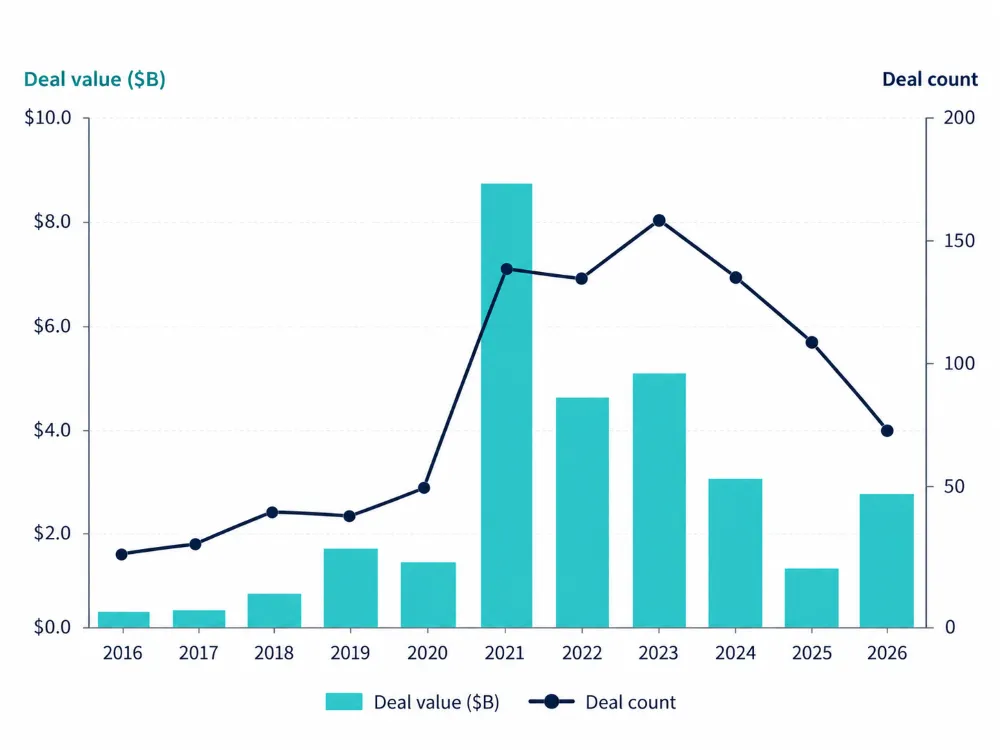
Source: PitchBook, data as of September 17, 2026
It is worth noting that the composition of investment is also changing. Lithium-ion remains the default stationary technology. At the same time, the capital is moving toward alternatives offering advantages in duration, material availability, safety, and cost.
Large 2026 rounds for Form Energy and Antora Energy readily illustrate this shift. The implication is that the investors back technologies designed for applications where conventional lithium-ion systems may be less economically suitable. Particularly, as demand for longer-duration storage solutions increases for stationary energy applications, the trend will gain even more momentum.
Conclusion
Underlying compute assets will still be vital for the future of AI. However, additional infrastructure will be necessary to support an ever-growing ability to deploy and generate value from new capacity. We believe this will extend to data centers and certainly transmission, grid optimization, and storage systems.
In short, as VC activity resumes and long-duration solutions return to prominence, the next phase of AI infrastructure investing will target both compute and power.
About SG Analytics
SG Analytics (SGA) is a global leader in data-driven research and analytics, empowering Fortune 500 clients across BFSI, Technology, Media & Entertainment, and Healthcare. A trusted partner for lower middle market investment banks and private equity firms, SGA provides offshore analysts with seamless deal life cycle support. Our integrated back-office research ecosystem, including database access, design support, domain experts, and tech-enabled automation, helps clients win more mandates and execute deals with precision.
Founded in 2007, SGA is a Great Place to Work® certified firm with 1,600+ employees across the U.S., the UK, Switzerland, Poland, and India. Recognized by Gartner, Everest Group, and ISG and featured in the Deloitte Technology Fast 50 India 2023 and Financial Times APAC 2024 High Growth Companies, we continue to set industry benchmarks in data excellence.
Related Tags
Author

Steve Salvius
Head of Investment Banking & Private Equity
