Scope 3 Categories Explained: All 15 with Examples and Calculation Methods
GHG emissions



October, 2026
A manufacturer may reduce the fuel it burns and the electricity it buys, yet still have a much larger climate footprint outside its facilities. Materials purchased from suppliers, freight moved by logistics partners, employee travel, and the use of products after sale all create emissions that direct operational reporting cannot capture. These are value-chain emissions, and they require a different approach to measurement.
The GHG Protocol groups this activity into 15 scope 3 categories. That classification gives sustainability and procurement teams a consistent way to identify sources, assign responsibility for data, avoid omissions, and prioritize action. Understanding the classification is the first step. Building a useful inventory requires selecting appropriate calculation methods and documenting where the underlying data came from.
What Are Scope 3 Emissions?
Scope 3 emissions are indirect greenhouse gas emissions that arise in an organization’s value chain but are not included in its own Scope 2 inventory. They can occur before materials or services reach the company, or after its products enter customer use and disposal. The GHG Protocol Corporate Value Chain Standard provides the framework for categorizing and accounting for these sources.
Consider a furniture business. Emissions from its own boilers are Scope 1. Emissions associated with purchased electricity are Scope 2. Timber production, transport contracted from logistics providers, employees’ commuting, and disposal of sold furniture can fall under Scope 3. A source must be assigned based on the reporting company’s relationship to the activity, not simply on where the emissions physically occur.
Scope 3 inventories help identify emissions exposure beyond direct operations. They do not, on their own, demonstrate that a product or company is environmentally preferable. Data quality, boundary choices, and subsequent reduction outcomes still matter.
What Are the 15 Scope 3 Categories?
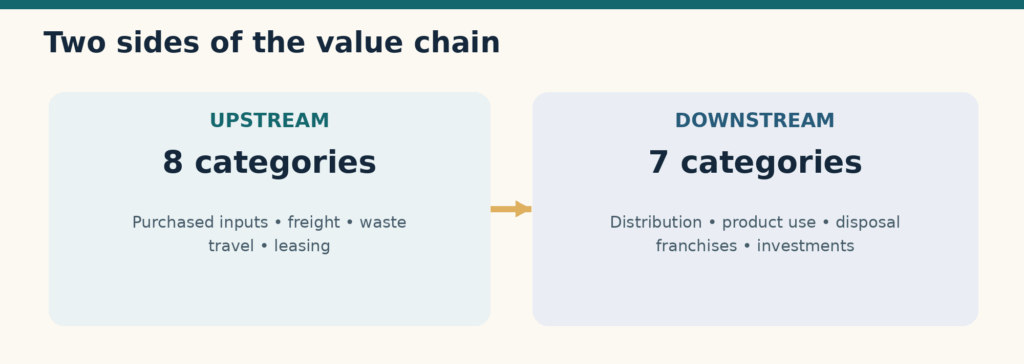
Scope 3 categories across the upstream and downstream value chain.
The scope 3 emissions categories are divided into upstream activities, which generally relate to inputs needed to operate, and downstream activities, which generally relate to the distribution, use, and end-of-life of outputs. The following reference table gives common examples and likely starting data sources. These scope 3 emissions examples illustrate classification and do not replace the GHG Protocol’s detailed minimum boundaries.
| No. | Category | Value-chain side | Typical example | Starting data |
|---|---|---|---|---|
| 1 | Purchased goods and services | Upstream | Raw materials and outsourced services | Supplier quantities, bills of materials, spend |
| 2 | Capital goods | Upstream | Machinery and new facilities | Asset purchase records, equipment specifications |
| 3 | Fuel- and energy-related activities | Upstream | Extraction and delivery of purchased fuel | Fuel and energy consumption, upstream factors |
| 4 | Upstream transportation and distribution | Upstream | Inbound and outbound freight paid for by the reporting business | Shipment weight, distances, modes |
| 5 | Waste generated in operations | Upstream | Treatment of factory waste | Waste mass and treatment routes |
| 6 | Business travel | Upstream | Flights and hotel stays | Travel bookings and activity data |
| 7 | Employee commuting | Upstream | Staff travel to work | Survey responses, commute distance and mode |
| 8 | Upstream leased assets | Upstream | Leased assets outside Scope 1 and 2 | Lease inventory, energy and usage records |
| 9 | Downstream transportation and distribution | Downstream | Customer distribution not paid for by seller | Distribution routes and carrier records |
| 10 | Processing of sold products | Downstream | Processing of sold intermediate materials | Customer process and volume estimates |
| 11 | Use of sold products | Downstream | Electricity used by sold appliances | Product lifetime and usage assumptions |
| 12 | End-of-life treatment of sold products | Downstream | Recycling or disposal of packaging | Material composition and waste pathways |
| 13 | Downstream leased assets | Downstream | Assets leased to another business | Asset operation and energy records |
| 14 | Franchises | Downstream | Franchisee operating emissions | Franchise activity and energy records |
| 15 | Investments | Downstream | Financed emissions associated with holdings | Investee emissions and financial exposure |
Different businesses have different material categories. A software services company may need to focus on purchased services, cloud infrastructure, and business travel. An appliance manufacturer may find that product use dominates. Screening all applicable categories before narrowing detailed data collection is generally more defensible than choosing categories because the information is easy to access.
Upstream Scope 3 Categories (Categories 1-8)
Upstream scope 3 categories describe activities that support a company’s operations but fall outside its direct and purchased-energy inventories. The classifications below can help procurement, facilities, HR and finance teams clarify who owns the data. These scope 3 emissions categories require distinct activity data and classification controls.
Category 1: Purchased Goods and Services
This category covers cradle-to-gate emissions of goods and services purchased in the reporting year, excluding purchases accounted for as capital goods. For a manufacturer, materials such as steel or plastics may dominate. A service organization may include purchased IT services, professional services and consumables. Quantity-based supplier data usually gives a clearer view than expenditure alone, provided supplier figures are comparable and well documented.
Category 2: Capital Goods
Machinery, vehicles and buildings acquired as capital assets belong here when their production emissions are relevant. The reporting treatment differs from financial depreciation: emissions from manufacturing the capital good are generally accounted for in the acquisition year rather than spread across its useful life. Procurement and fixed-asset records help identify the population of purchases.
Category 3: Fuel- and Energy-Related Activities (Not Included in Scope 1 or 2)
This category includes upstream activities associated with fuel and energy consumed by the reporting company, such as extraction, production and transportation of fuels, and relevant transmission and distribution losses. It should not duplicate combustion emissions already booked in Scope 1 or electricity-generation emissions already booked in Scope 2. Energy bills and appropriate upstream emission factors are key inputs.
Category 4: Upstream Transportation and Distribution
Freight and distribution services purchased by the reporting company, including movements between its suppliers and operations or third-party warehousing when applicable, can fall into Category 4.This includes inbound movements between its suppliers and operations, third-party warehousing when applicable, and outbound logistics that the company pays for. Category 9 covers only distribution the company does not pay for. Shipment weights, routes, transport modes and logistics-provider fuel data are useful. Ownership of a vehicle and who purchases the logistics service affect the classification, so contracts should be checked rather than relying on geography alone.
Category 5: Waste Generated in Operations
This includes emissions from third-party treatment and disposal of operational waste. A company should distinguish landfill, recycling, incineration and wastewater treatment because associated factors and boundaries differ. Reliable waste tickets and treatment-provider information can materially improve estimates.
Category 6: Business Travel
Flights, rail, hired road transport and certain accommodation-related emissions may be included under relevant boundaries. Corporate travel platforms provide starting records, but itinerary details, fare classes and hotel nights should be reviewed for completeness. The organization should apply one consistent methodology rather than mixing incompatible booking and expense estimates.
Category 7: Employee Commuting
Employee travel between home and the normal workplace can be estimated using commute surveys, attendance records and transport-mode assumptions. Remote-working emissions may be addressed where relevant under the accounting framework and documented method. Survey samples should reflect actual hybrid work patterns, not only office-based staff.
Category 8: Upstream Leased Assets
This covers emissions from the operation of leased assets not already included in the company’s Scope 1 or Scope 2 inventory under its chosen organizational boundary. The deciding factor is the reporting company’s accounting boundary and control approach. Lease terms, property energy data and responsibility for operations must be reviewed together.
Downstream Scope 3 Categories (Categories 9-15)
Downstream emissions arise after goods or services leave the company, including distribution, further processing, product use and certain financed or licensed activities. Some categories will not apply to every business model.
Category 9: Downstream Transportation and Distribution
Transportation, distribution and storage of sold products after sale can fall under Category 9 when the related transport services are not purchased by the reporting company. This distinction helps prevent double counting with Category 4. Distributor shipment records and route assumptions can inform calculations.
Category 10: Processing of Sold Products
Companies selling intermediate products may need to account for additional processing by customers. For example, a specialty material may undergo molding, cutting or chemical processing before it becomes a finished product. The calculation requires plausible processing pathways and energy intensities, not merely the sales value of the intermediate material.
Category 11: Use of Sold Products
This can be material for products that consume energy or fuel during use, such as appliances or vehicles. Typical inputs include expected lifetime, operating hours, energy consumption and usage conditions. Companies should distinguish direct use-phase emissions from indirect use-phase assumptions and disclose methods clearly.
Category 12: End-of-Life Treatment of Sold Products
Packaging, appliances, furniture and other goods may be recycled, landfilled or incinerated after use. Estimates depend on sold material mass, expected treatment shares and local waste-management assumptions. A recycling claim is not a substitute for a defensible waste-treatment scenario.
Category 13: Downstream Leased Assets
Companies leasing out assets may account for operating emissions from those assets when the emissions do not fall within their Scope 1 or 2 boundary. It is important to distinguish Category 13 from Category 8 and avoid reporting the same leased asset in conflicting categories.
Category 14: Franchises
A franchisor may include emissions associated with franchise operations not already counted in its direct inventory. Store energy, refrigerants and franchisee operational records can be useful, but boundary and ownership assumptions should be explicit.
Category 15: Investments
Investors and financial institutions may need to account for emissions associated with equity, debt and other covered investments, subject to the relevant minimum boundaries. Financial institutions often supplement the GHG Protocol with PCAF methods for financed emissions. Attribution methods and investee data quality should be disclosed.
How to Identify Which Scope 3 Categories Are Relevant to Your Business
Start with the operating model. Draw a simple map from purchased inputs to manufacturing or service delivery, distribution, customer use and disposal. Then test each category for applicability, scale, stakeholder relevance and availability of reliable data. Screening should also examine categories that may be material but poorly measured.
An initial screening matrix might record whether a category applies, probable emissions significance, the responsible internal team, available primary data and the next action. A low-quality estimate can signal a data gap, but it is not evidence that emissions are immaterial. Revisit the assessment after acquisitions, product changes or major shifts in supplier relationships.
How to Calculate Scope 3 Emissions: Step-by-Step
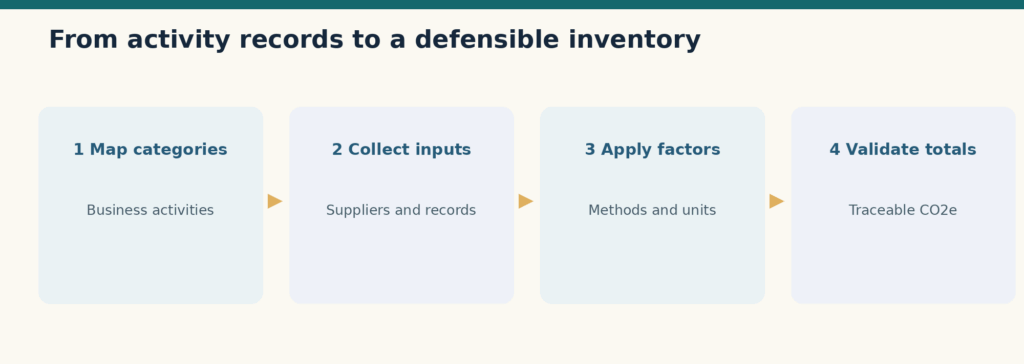
Scope 3 emissions calculation workflow from data collection to review.
Define the reporting entity, period and category boundaries
Use the same organizational consolidation approach and reporting period as the corporate inventory. Review the GHG Protocol’s minimum and optional category boundaries and record exclusions with reasons.
Map activities, suppliers, and customer use phases
Create a register of material purchases, transportation legs, leased assets, waste flows, product lines and downstream pathways. Assign business owners who can validate volumes and assumptions rather than relying on a single sustainability analyst.
Gather activity, supplier-specific and secondary data
Choose data that represents the actual activity. Supplier-reported product footprints, tonnes of material, tonne-kilometers of freight and energy use are typically more informative than aggregated expenditure. Keep supplier reference years and units with every record.
Choose suitable methods and emission factors
Match each activity to the method supported by the standard and available evidence. Validate factor boundaries, geographic applicability, units and publication year. Do not combine supplier and database factors without checking for embedded upstream processes already covered elsewhere.
Calculate, quality-check and document each category
Convert to a common unit such as tonnes of carbon-dioxide equivalent (tCO2e). Reconcile totals to procurement and operating data, compare year-on-year movement, document estimates and retain calculation files. The Scope 3 Calculation Guidance describes category-specific methods and decision rules.
Scope 3 Calculation Methods: Supplier-Specific, Hybrid, Average-Data and Spend-Based
Supplier-specific and hybrid approaches
Supplier-specific methods use measured or supplier-provided emissions tied to relevant products or activities. These methods improve the scope 3 calculation when their source evidence is robust. Hybrid approaches combine supplier primary data for some processes with secondary factors for missing activities. These methods can strengthen decision-usefulness, but only when boundary definitions and supplier verification are robust.
Average-data and spend-based approaches
Average-data methods multiply physical activity, such as kilograms of material, by sector-average factors. Spend-based methods use economic activity and environmentally extended input-output factors. Spend-based screening is useful when detail is scarce, but changing prices can create emissions movement unrelated to physical decarbonization.
Distance/fuel-based methods where applicable
Transport can be calculated using fuel used by a fleet or tonne-kilometers, distance and mode. Travel and distribution methodology should reflect vehicle assumptions, occupancy, payload and other relevant boundaries. Use the most representative method feasible and document the limitations.
Scope 3 Emissions Calculation Example
Consider a company purchasing 12,000 kilograms of a material in one reporting year. For an illustrative exercise, assume an appropriate cradle-to-gate factor of 2.4 kgCO2e per kilogram of material. The numbers are invented for teaching and are not supplier declarations or official default values.
| Input | Illustrative value |
|---|---|
| Purchased material quantity | 12,000 kg |
| Assumed material emission factor | 2.4 kgCO2e/kg |
| Estimated emissions | 28,800 kgCO2e |
| Converted result | 28.8 tCO2e |
The calculation is 12,000 kg x 2.4 kgCO2e/kg = 28,800 kgCO2e, or 28.8 tCO2e. This could be one line in Category 1, not the company’s complete inventory. Before publication, a real example should cite the factor source, reference year, geographic coverage, lifecycle boundary and uncertainty.
Common Scope 3 Data Collection and Reporting Challenges
The hardest problem is often not the arithmetic. Businesses may have incomplete supplier responses, inconsistent material units, emissions factors with different cradle-to-gate boundaries and delayed purchase records. Acquisitions or new logistics contracts can also change the baseline.
Category overlap is another risk. A freight invoice could be counted both under purchased services and transport unless the accounting policy specifies treatment. Effective ESG data collection and validation uses controlled classifications, evidence trails and exception logs to make calculations reproducible.
How to Improve Scope 3 Data Quality and Reduce Emissions
Prioritize the combination of materiality and data quality. Begin with high-emission categories, then replace broad estimates with more specific activity data. Ask major suppliers for comparable product or facility emissions and document their methodologies. Maintain a governed emission factor library and a change log for corrections and restatements.
Once hotspots are credible, the conversation moves to purchasing specifications, logistics design, product efficiency and supplier targets. Supplier emissions data collection and engagement can connect inventory development with practical change. Reduction claims should reflect actual comparable activity and should not be inferred from improved calculation methods alone.
Scope 3 Reporting: What the GHG Protocol Requires
The Corporate Value Chain Standard establishes scope 3 accounting and reporting requirements for organizations choosing to prepare an inventory against it. It provides category-based coverage, methodology, boundary and disclosure expectations. The purpose of scope 3 reporting is to make material value-chain sources visible and the resulting inventory transparent.The 2011 Scope 3 Standard remains in force but is being folded into the combined GHG Protocol–ISO corporate standard. See our Greenhouse Gas Protocol guide for the 2026 update.
A GHG accounting standard is not itself a universal law. Whether a company is legally required to disclose particular Scope 3 information depends on the applicable jurisdiction, reporting framework, industry, size and effective dates.
Examples include:
- California’s SB 253: CARB regulations took effect on October 12, 2026, with first Scope 1 and 2 reports due November 10, 2026, and Scope 3 reporting starting in 2027.
- CSRD/ESRS E1: Scope was recently revised under the EU Omnibus package; confirm whether your company is still covered.
- IFRS S2: Check these obligations separately from voluntary GHG Protocol conformity.
SGA’s greenhouse gas inventory and accounting support can help establish the data and documentation needed for multiple reporting uses.
Frequently Asked Questions About Scope 3 Categories
Scope 3 emissions are indirect greenhouse gas emissions associated with a company’s upstream and downstream value chain, excluding purchased-energy emissions already counted in Scope 2. Examples include the production of purchased materials, business travel, customer use of sold products and disposal at end of life. Relevance depends on the company’s activities and reporting boundaries.
The 15 categories consist of eight upstream sources and seven downstream sources. They cover purchased goods, capital goods, energy-related activities, logistics, waste, business travel, commuting, leased assets, processing, product use, end-of-life treatment, franchises and investments. The complete table above lists each category and the data commonly needed to estimate it.
Start by screening the 15 scope 3 categories for applicability. Gather relevant purchases, supplier, transport and use-phase data. Apply appropriate supplier-specific, hybrid, physical-average or spend-based calculations. Convert the outputs to tCO2e, check boundaries and factor units, and document assumptions and missing data before consolidating an inventory.
Identify material hotspots before setting reduction priorities. Common actions include specifying lower-carbon materials, improving freight utilization, designing efficient products, and working with suppliers to reduce process emissions. Update the inventory consistently so that measurable reductions can be distinguished from changes in factors, price effects, or data quality.
There is no single global rule requiring every company to report Scope 3 emissions. Disclosure requirements depend on the laws and frameworks applicable to the organization. The GHG Protocol offers an accounting standard, whereas legally binding reporting mandates come from regulators or other applicable requirements. Companies should assess both separately.
SG Analytics supports organizations in identifying relevant Scope 3 sources, collecting supplier and operational data, applying appropriate methodologies and developing transparent inventories. Its greenhouse gas inventory and accounting support can help teams manage category boundaries, validate calculations and establish repeatable reporting processes.
SG Analytics can support standardized supplier requests, data validation, emission factor mapping and documented calculation controls. By improving traceability and helping teams use activity-based information where feasible, these processes can make estimates more comparable and easier to review. Accuracy still depends on the source data and chosen methodology.
SG Analytics supports emissions assessments and hotspot analysis that reveal which purchased materials, suppliers or value-chain activities contribute most to the inventory. This can guide data collection, supplier engagement and decarbonization priorities. The analysis should be revisited as production volumes, suppliers and emission factors change.
SG Analytics helps organizations develop documented GHG baselines, monitor changes and connect emissions findings to operational priorities. Its carbon measurement and research support can complement category-level reporting with analysis that supports decisions about suppliers, operations and long-term emissions management.
What Scope 3 Measurement Means for Enterprise Sustainability Decisions
A Scope 3 inventory should change decisions, not simply fill a disclosure table. Procurement teams need to know where supplier data is weakest. Finance teams need to understand whether emissions move because business volumes grew. Product leaders need clarity on how customer use and end-of-life assumptions shape the reported result.
The value of understanding these value-chain categories lies in using one consistent classification to make those conversations possible. A strong inventory identifies the emissions that matter, names the uncertainties that remain and provides a basis for credible reduction plans. For businesses scaling their programs, better GHG accounting and supplier data capabilities turn sustainability reporting into a more reliable management tool.
Read More from SG Analytics
- ESG Data Challenges
- Decarbonizing Industries
- 5 Key Components of a Sustainability Data Strategy
- Greenhouse Gas Protocol Explained
References
Related Tags
Author
SGA Knowledge Team