Greenhouse Gas Protocol Explained: Corporate GHG Accounting and Reporting Guide
GHG emissions



October, 2026
An emissions number is useful only when the organization can explain what it covers, how it was calculated and whether it can be compared with earlier years. One team may count leased facilities, another may omit them. Electricity contracts can change the reported result even when consumption stays constant. Without common rules, year-on-year movement can reflect accounting choices rather than operational performance.
The greenhouse gas protocol provides a standardized foundation for corporate emissions measurement. Its standards help businesses determine which entities and activities belong in their inventory, distinguish direct from indirect emissions and communicate calculation choices to investors, customers and assurance providers. Used properly, the framework creates data that supports decisions rather than just disclosure.
What is the Greenhouse Gas Protocol (GHG Protocol)?
The Greenhouse Gas Protocol is a widely used suite of greenhouse gas accounting standards and guidance developed through an initiative led by the World Resources Institute and the World Business Council for Sustainable Development. Its Corporate Accounting and Reporting Standard sets principles and rules for preparing organization-level emissions inventories.
The greenhouse gas protocol is not a global regulator. It provides accounting methods that businesses and reporting programs can adopt or reference. A company may voluntarily use the Corporate Standard, while separately facing mandatory disclosures under relevant local law. The standard itself does not require companies to submit reports to GHG Protocol.
Read more: 5 Key Components of a Sustainability Data Strategy
The Corporate Standard addresses the principal greenhouse gases, including carbon dioxide, methane, nitrous oxide and groups of fluorinated gases. Results are typically expressed as carbon-dioxide equivalent (CO2e) using appropriate global warming potential factors so that different gases can be aggregated.
Which GHG Protocol Standards Apply to Companies?
Corporate Accounting and Reporting Standard (Corporate Inventory Foundation)
The Corporate Standard establishes the foundation for organization-level inventories, covering consolidation, boundary selection, five accounting principles and transparent presentation of emissions. It is the starting point for teams building a baseline across business units or countries.
Scope 2 Guidance (Purchased Energy, Dual Reporting)
The GHG Protocol Scope 2 Guidance describes accounting for purchased or acquired electricity, steam, heat and cooling. In markets where contractual instruments are available, companies must report both location-based and market-based scope 2 reporting. The guidance also sets quality criteria for relevant energy instruments.
Corporate Value Chain (Scope 3) Standard (Value-Chain Emissions Overview and Link to Blog #1)
The Scope 3 Standard covers indirect emissions beyond purchased energy, including supply-chain activity and the use of sold products. It establishes 15 categories and corresponding accounting boundaries. For the detailed category list, see SGA’s forthcoming guide to Scope 3 categories, which should be cross-linked after that article is published.
Product Standard and Other Sector-Specific Guidance (What Each is for)
The Product Life Cycle Accounting and Reporting Standard addresses product footprints over lifecycle stages. Separate calculation tools and sector-specific guidance help with particular activities. Corporate and product inventories answer different questions, so their totals should not be assumed to match or simply be added together.
Read more: ESG Data Challenges
The Five GHG Accounting and Reporting Principles
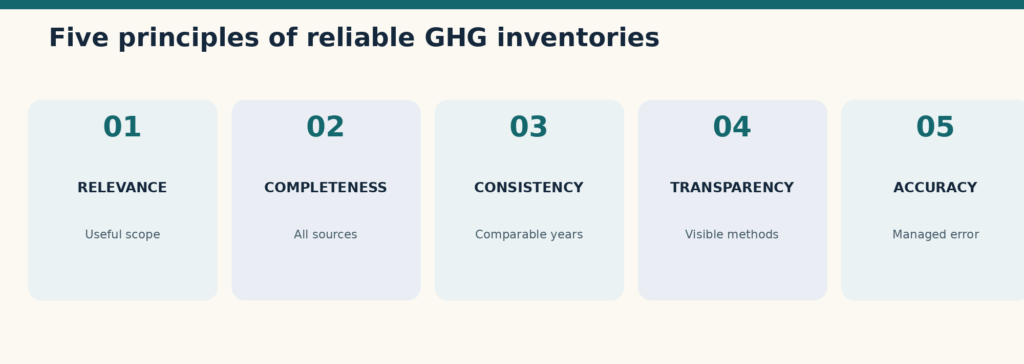
Greenhouse gas protocol five reporting principles.
The five principles of greenhouse gas accounting guide decisions when data is incomplete or multiple methodological options exist. They also provide a useful quality-assurance checklist for reviewers.
Relevance, Completeness, Consistency, Transparency, and Accuracy
| Principle | What it means in practice |
|---|---|
| Relevance | Set boundaries and methods that reflect the organization’s activities and users’ decisions. |
| Completeness | Include applicable emission sources within the chosen boundary and explain justified exclusions. |
| Consistency | Use comparable methods across periods and explain material changes or recalculations. |
| Transparency | Document factors, source data, assumptions, methods and limitations. |
| Accuracy | Reduce systematic errors and uncertainty as far as practicable without claiming false precision. |
These are interdependent. An estimate built from consistent but incomplete data is still weak. An accurate calculation without traceable source records is difficult to assure. The purpose of the principles is disciplined judgment, not a claim that every emissions figure is exact.
How to Set Organizational and Operational Boundaries
Before collecting electricity or fuel data, decide which subsidiaries, joint ventures, facilities and leases belong to the reporting organization. This choice influences both the inventory total and the classification of emissions.
Equity Share Approach
Under equity share consolidation, a company accounts for emissions from an operation according to its share of equity in that operation, subject to the standard’s guidance. This can be relevant for joint ventures and investment structures where ownership differs from managerial control.
Financial Control Approach
Under financial control, an organization generally accounts for 100% of emissions from operations over which it can direct financial and operating policies for economic benefit, as determined under the selected accounting criteria. Investments without such control may receive a different treatment. The approach must be applied consistently.
Operational Control Approach
Under operational control, the reporting organization generally accounts for 100% of emissions from operations for which it has authority to introduce and implement operating policies. A contractor’s or joint venture’s legal ownership alone does not settle operational control. Relevant agreements and actual decision rights should be reviewed.
Operational Boundary: Assign Scope 1, Scope 2 and Scope 3
Once the entities are established, classify emissions within the operational boundary. A diesel boiler controlled by the reporting company generally produces Scope 1 emissions. Purchased electricity generally produces Scope 2 emissions. Many contracted transport and purchased-material activities fall into Scope 3. A boundary register should identify the decision taken for each material operation and why.
Read more: Decarbonizing Industries
GHG Protocol Scopes 1, 2, and 3: What Falls into Each?
The ghg protocol scopes separate different relationships to emissions sources. Scope 1 comprises direct emissions from sources owned or controlled under the accounting boundary, such as combustion in company boilers or refrigerant leakage. Scope 2 covers emissions from generation of purchased or acquired energy consumed by the organization. Scope 3 covers other indirect upstream and downstream value-chain emissions.
| Scope | Illustrative sources | Useful primary records |
|---|---|---|
| Scope 1 | Company fleet fuel, boilers, fugitive refrigerants | Fuel bills, meters, refrigerant top-up records |
| Scope 2 | Purchased electricity, steam, heat and cooling | Utility bills, energy meters, supplier contracts |
| Scope 3 | Purchased materials, outsourced freight, product use, investments | Procurement data, supplier records, product and travel activity |
This overview is deliberately high-level. A correct classification depends on organizational boundaries and the relevant guidance. The corporate inventory should neither ignore large value-chain sources nor mix gross physical emissions with carbon-offset purchases.
How to Build a Corporate GHG Inventory: Step by Step
Select reporting year, base year and consolidation approach
Agree on the organizational unit, fiscal or calendar reporting period and base year. Choose the equity share, financial control or operational control approach, then establish when acquisitions, divestments or methodological corrections will trigger a base-year recalculation.
Identify facilities, operations and emission sources
Build a source register across offices, factories, warehouses, vehicles, process equipment, leased locations and purchased services. Assign one operational owner per source and map each item to an emission scope. A register is more robust than relying on last year’s utility invoices alone.
Collect fuel, electricity, refrigerant and selected value-chain activity data
Gather physical quantities and source documentation. Examples include liters of diesel, kilowatt-hours of electricity, kilograms of refrigerant added or released and tonnes of purchased inputs. Require dates, units, site identifiers and invoices or meter extracts wherever available.
Select appropriate emission factors and global warming potentials
Use documented factors that match the geography, time period, fuel, process and unit of the activity. For non-CO₂ gases, apply 100-year IPCC global warming potential (GWP) values, as the standard requires, and use the most recent IPCC Assessment Report, as it recommends. The seven required gases are CO₂, CH₄, N₂O, HFCs, PFCs, SF₆, and NF₃. Express results as CO₂e. Mixing factors from incompatible years or methodological boundaries makes comparisons harder to defend.
Calculate, consolidate, validate and document results
Calculate at the activity or site level, then aggregate to the reporting entity. Reconcile energy with finance and facility systems, check outliers and record estimates. A basic inventory table might contain: business unit, facility, source, scope, activity, unit, factor, factor source, CO2e result, data owner, evidence link and review status.
GHG emissions inventory and accounting support can help turn these dispersed inputs into repeatable controls rather than a once-a-year spreadsheet exercise.
How to Calculate GHG Emissions with Activity Data and Emission Factors
Most activity-based emissions calculations follow a simple logic: physical activity multiplied by a relevant emission factor gives emissions in consistent units. The difficulty is selecting the factor, identifying which gases it includes and confirming that the units cancel correctly.
Formula: activity data x relevant emission factor = emissions (check units and CO2e conversions)
If a factor is expressed as kgCO2e per kilowatt-hour, multiplying by kilowatt-hours produces kgCO2e. Divide by 1,000 to convert kilograms to tonnes. If the source factor reports kilograms of individual gases, convert using the applicable global warming potential basis before aggregating to CO2e.
Mini-example: purchased grid electricity; clearly label illustrative data and factors
Assume, solely for illustration, that a facility purchases 85,000 kWh of electricity and a suitable location-based factor is 0.42 kgCO2e/kWh. These are teaching inputs, not current official factors for a real grid.
| Element | Illustrative value |
|---|---|
| Electricity used | 85,000 kWh |
| Assumed location-based factor | 0.42 kgCO2e/kWh |
| Calculated emissions | 35,700 kgCO2e |
| Reported result | 35.7 tCO2e |
The result is 85,000 x 0.42 = 35,700 kgCO2e, or 35.7 tCO2e. This calculation belongs in a location-based Scope 2 estimate if the factor and boundary are appropriate. It does not establish the facility’s market-based result.
Scope 1 example: stationary combustion or refrigerant leakage
For direct combustion, use fuel consumed with a suitable fuel-specific factor, taking care over whether the factor covers CO2 alone or CO2e. Refrigerant leakage generally requires identifying the chemical, mass released and correct global warming potential. A generic fuel factor must not be applied to refrigerants.
Read more: Scope 3 Categories Explained
How to Report Scope 2 Emissions Using Location-Based and Market-Based Methods
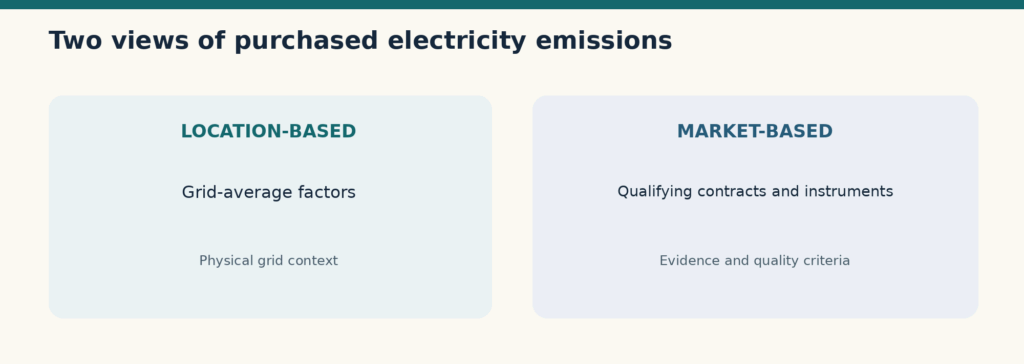
GHG Protocol Scope 2 location-based and market-based method comparison.
Location-Based Approach: Average Grid Emission Factor
The location-based method reflects the average emissions intensity of electricity grids where consumption occurs. Companies generally combine measured electricity demand with suitable geographic factors for the reporting period. It allows readers to understand the physical-grid context of the organization’s electricity use.
Market-Based Approach: Contractual Instruments and Evidence Requirements
The market-based method reflects qualifying contractual choices such as energy supply agreements or certificates that meet GHG Protocol quality criteria. Reporters must retain evidence about vintage, market boundaries, claims and any residual-mix factors applicable to purchases not covered by qualifying instruments. A claim that a site uses renewable electricity is not sufficient documentation on its own.
Where dual reporting applies, present location-based and market-based results separately. Avoid averaging the two or substituting one for the other because they represent different accounting lenses. The Scope 2 Guidance provides the required treatment.
Corporate GHG Reporting: What Information Should Be Disclosed?
Good ghg emissions reporting identifies the legal entity and reporting boundary, gases covered, reporting year and selected consolidation approach. It separately presents gross Scope 1 and Scope 2 results, explains the Scope 2 methods, and reports relevant Scope 3 results when the applicable standard or reporting program requires them.
Useful accompanying disclosures include calculation methodologies, factors, base year, changes in scope, material exclusions, uncertainty, recalculations and the status of external assurance. An inventory should distinguish gross emissions from offsets or avoided-emissions claims rather than netting those numbers into operational totals.
A voluntary accounting standard and a mandatory disclosure program serve different functions. The former defines how to measure. The latter may specify who must disclose, when, to whom, and at what assurance level. For companies using multiple frameworks, reliable ESG data quality and standardization can help maintain a consistent source of emissions data while meeting different reporting formats.
Common GHG Data Quality, Boundary and Assurance Challenges
Several preventable issues regularly undermine ghg reporting. Facilities may submit mixed units. Utility periods may cross fiscal-year boundaries. An acquired subsidiary may not follow the same consolidation approach. Suppliers may report inconsistent emissions factors or unverified carbon claims. Changes in calculation methods can appear as reductions or increases in reported results.
Organizations should maintain written policies for factor selection, estimates, document retention, data ownership and review. Validate large year-on-year movements, retain restatement decisions and preserve source evidence. Assurance readiness is an outcome of traceable workpapers and consistent controls, not a guarantee that external verification will find no issues.
GHG Protocol Updates in 2026: What is Current and What is Proposed?
The Greenhouse Gas Protocol continues to evolve. On July 29, 2026, GHG Protocol announced that it and ISO will combine their corporate standards (the Scope 1, 2, and 3 standards, the Actions and Market Instruments work, and ISO 14064-1) into one co-branded standard. The ISO partnership itself was set up in 2025. The July communication indicated a joint public consultation in Q2 2027 and an expected publication in Q4 2028. The existing Corporate
Standard, Scope 2 Guidance and Scope 3 Standard remain the published references until adopted revisions replace them. The same release published the Scope 2 consultation results, which drew nearly 1,100 responses from 56 countries, and work on reporting the impacts of climate actions continues.
Any new approach still has to pass the technical working group and the Independent Standards Board, so it is not yet a requirement. Consultation findings are not automatically new requirements. Businesses should follow official updates and avoid rewriting inventories around tentative proposals. See GHG Protocol’s 2026 development update for the published status and timeline.
Frequently Asked Questions About the Greenhouse Gas Protocol
The GHG Protocol is a set of standards and guidance for measuring and reporting greenhouse gas emissions. Its corporate guidance helps businesses set reporting boundaries, classify Scope 1, 2 and 3 sources, perform calculations and disclose results transparently. Organizations can use it voluntarily or to support requirements set by regulators and reporting programs.
No. The standard is not itself a universal reporting law. A company may choose it as an accounting basis, while applicable local regulation or another reporting framework may require specific disclosures. Whether reporting is mandatory depends on the company’s jurisdiction, size, activities and the rules in force.
Scope 1 covers direct emissions from sources within the reporting company’s defined control or ownership boundary. Scope 2 covers emissions from purchased or acquired energy. Scope 3 covers other indirect emissions across upstream and downstream activities. The boundary method determines how particular facilities, leases and investments are classified.
Companies multiply suitable activity data by documented emission factors, convert results to CO2e and aggregate them under a consistent reporting boundary. They then reconcile source records and review assumptions. Verification, when undertaken, involves independent assessment against relevant criteria and is distinct from simply checking arithmetic.
The updates aim to improve the consistency, interoperability and usability of corporate emissions accounting. A July 2026 announcement describes plans to combine the GHG Protocol and ISO corporate standards into a single harmonized standard, alongside the published Scope 2 consultation results and work on climate-action reporting. These proposals remain part of a development process and should not be confused with finalized requirements.
SG Analytics supports organizations with emissions-source mapping, consolidation boundaries, activity-data collection, factor selection and inventory development. Its GHG inventory and accounting support helps teams establish a documented basis for calculating Scope 1, Scope 2 and relevant value-chain emissions.
Yes. SG Analytics supports structured inventory calculations, data validation, evidence trails, documented assumptions and review controls. These processes can improve readiness for independent assurance. External assurance remains a separate assessment performed against applicable criteria and cannot be guaranteed by the inventory-preparation provider.
SG Analytics can organize emissions information to support disclosures under frameworks such as CDP, CSRD/ESRS and IFRS S2, where applicable. A consistent dataset reduces duplication, but teams still need to evaluate each program’s definitions, reporting boundaries, materiality rules and disclosure requirements separately.
SG Analytics combines ESG-domain workflows with data processing, validation and automation capabilities. Automating data intake and exception management can reduce manual reconciliation while preserving review checkpoints. The strongest systems keep source documents, calculation logic and decisions accessible for audit and reporting users.
What Stronger Emissions Data Means for Corporate Decision-Making
Corporate greenhouse gas accounting is most valuable when the same measures inform capital allocation, operational targets and procurement decisions. Comparable inventories can reveal whether a reduction came from lower energy use, cleaner electricity, asset disposals or a change in data methods. They can also show where supplier information remains too weak for confident action.
Applying the greenhouse gas protocol consistently is a foundation for that work. Companies that invest in clear boundaries, controlled methods and accountable data owners are better positioned to manage decarbonization decisions and communicate defensible results. Carbon data collection and emissions measurement and supplier emissions data and value-chain support can extend that discipline beyond direct operations.
References
Related Tags
Author

SGA Knowledge Team