CBAM Reporting 2026: Requirements, Embedded Emissions Calculations and Compliance Checklist
GHG emissions



November, 2026
The EU Carbon Border Adjustment Mechanism, or CBAM, moved from its transitional phase to a definitive regime on 1 January 2026. For affected importers, the work is no longer limited to the quarterly reporting approach used during the transitional period. Businesses now need to determine whether imports meet the new threshold, secure the appropriate declarant status where required and maintain defensible product-level emissions data for the first annual declaration.
The timing matters. Covered imports made in 2026 create the underlying monitoring and accounting obligations. The first annual declaration for the 2026 calendar year is due on 30 September 2027, and certificate purchasing for 2026 emissions begins in February 2027. This approach requires a reliable 2026 ledger now, even though the first annual filing occurs later. This article outlines the current rules, updated to reflect developments as of late October 2026, alongside an illustrative calculation and a practical checklist to determine goods in scope by customs classification (CN code).
Important Note: The Commission proposed extending CBAM to about 180 downstream products in December 2025. Parliament adopted its position on September 15, 2026, and the first trilogue on October 20, 2026, ended without a deal. Law-firm commentary puts Parliament’s list at 457 products versus about 200 for the Council. None of this is law yet.
What is CBAM, and Why Does the EU Apply It?
CBAM places a carbon-pricing mechanism on the embedded emissions of specified carbon-intensive goods imported into the European Union. It is intended to address carbon leakage, a situation in which emissions-intensive production moves outside the EU or imports replace EU production subject to a different carbon-pricing burden.
The European Commission’s CBAM overview explains the link to the EU Emissions Trading System, or EU ETS. CBAM is not a general tax on every imported product. Its application depends on particular goods, customs classifications, the importer’s status and detailed rules for calculating embedded emissions and certificate adjustments.
Who Must Comply with CBAM Reporting in 2026?
Authorized CBAM declarants: EU importer versus indirect customs representative
The EU importer or, where applicable, an indirect customs representative is responsible for declarant arrangements under the regime. Businesses above the relevant de minimis threshold generally need authorized CBAM declarant status. An application must be filed before the 50-tonne threshold is crossed. Processing times vary, so confirm timing with your national competent authority. Teams should check the legal and registry responsibilities of the entity named in customs filings rather than assume the supplier is automatically the regulated declarant.
Non-EU installation operators: their data and evidence responsibilities
A plant outside the EU supplying covered goods may not be the party that files the EU declaration, but the importer depends on its information. Installation operators should be prepared to provide product, production process, relevant input, emissions and verification data under the applicable methodology. Commercial contracts should assign responsibility for evidence quality, revisions and delivery deadlines.
Read more: Carbon Markets: Challenges and Opportunities
Determine goods in scope by customs classification (CN code)
Classification begins with the Combined Nomenclature (CN) code, not simply a description such as ‘steel component.’ Importers should reconcile customs codes, origin, goods descriptions and applicable annexes. A broadly similar downstream product may fall outside the existing covered list. Proposed future expansions must not be treated as current law until adopted.
Which Goods and Sectors Are Covered by CBAM?
The current CBAM regulation applies to selected goods across six sectors. Exact coverage depends on the annexed CN codes and applicable product descriptions, so broad sector labels below are only a starting screen.
| Covered sector | Example operational data to request | Classification checkpoint |
|---|---|---|
| Cement | Process emissions, fuel use, production volume | Product type and covered CN code |
| Iron and steel | Installation process, relevant precursors, product mass | Alloy/product classification and CN code |
| Aluminium | Primary or secondary production inputs, electricity, process data | Specific aluminium good and CN code |
| Fertilisers | Process inputs, energy, production volume | Product chemistry and listed CN code |
| Electricity | Electricity quantity and applicable carbon intensity | Electricity-specific measurement and rules |
| Hydrogen | Hydrogen production pathway and emissions intensity | Hydrogen-specific code and methodology |
For each product, maintain a classification memo and a record of the data source. Use the European Commission’s sector information and consolidated legislation when confirming coverage. This is more reliable than assigning CBAM status from a supplier’s commercial description alone.
The 50-Tonne CBAM Threshold: How the 2026 Exemption Works
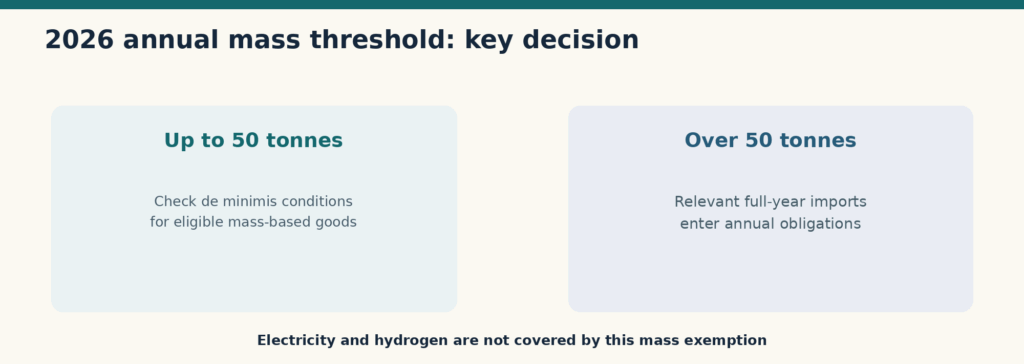
CBAM 50-tonne threshold decision flow with electricity and hydrogen exceptions.
A major change introduced in 2025 provides a single annual mass-based de minimis threshold of 50 tonnes for covered goods in the cement, fertilisers, iron and steel, and aluminium sectors. The calculation is based on cumulative net mass imported by the relevant importer during the calendar year, not a separate 50-tonne allowance for each shipment or each product category.
Annual cumulative net mass across covered cement, fertilisers, iron/steel and aluminium imports
A business importing 18 tonnes of covered steel and 35 tonnes of covered aluminium over 2026 exceeds 50 tonnes in aggregate. Subject to the legal conditions, its obligations then cover relevant full-year imports, not only the three tonnes above the threshold. Importers should use customs data to track cumulative mass and possible changes during the year.
Read more: ESG Data Challenges
Electricity and hydrogen are not covered by the 50-tonne de minimis exemption
Electricity and hydrogen have separate treatment and cannot simply be folded into the mass exemption. Other exclusions or special circumstances may also apply under the legal text. A classification check should precede any assumption that a small import flow is exempt.
Threshold exceeded: explain full-year obligations (not just tonnes above threshold)
Exceeding the threshold is a compliance trigger, not a deduction from the volume used in the annual declaration. Teams should preserve data from the first covered shipment even when they expect annual volume to remain below the exemption. That avoids costly reconstruction if shipments later push the importer over 50 tonnes.
CBAM Reporting Timeline: 2026 Activity and 2027 Filing Deadlines
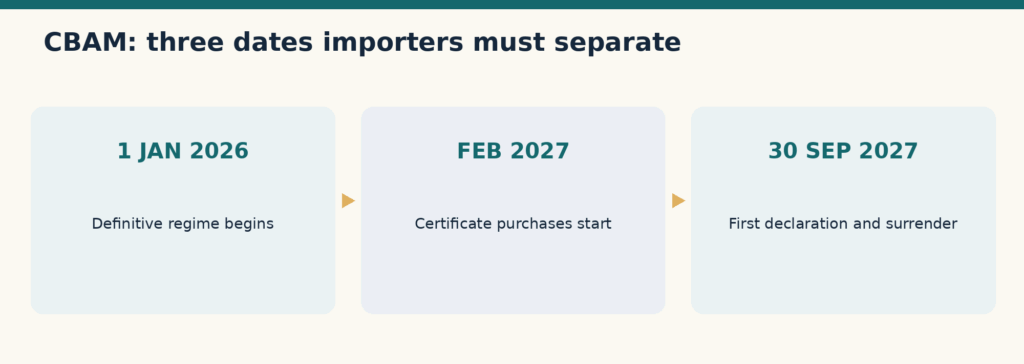
CBAM reporting 2026 to 2027 compliance timeline.
| Period | What importers and suppliers should do |
|---|---|
| October 2023-December 2025 | Transitional phase: quarterly reporting under the transitional framework. |
| 1 January 2026 onward | Definitive regime starts. Apply scope, threshold and authorisation rules and maintain 2026 import and emissions data. |
| Throughout 2026 | Collect producer data, check CN classifications, maintain evidence and monitor quarterly EU ETS-linked reference prices. |
| February 2027 afterwards | Purchase CBAM certificates for 2026 emissions through the central platform under the relevant rules. From 2027, at the end of each quarter – Hold certificates covering at least 50% of embedded emissions to date. |
| 30 September 2027 | First annual CBAM declaration for calendar year 2026 and associated surrender obligations are due. |
This sequencing is central to annual filing requirements. A compliance calendar should separate the period when imports and emissions are measured from the period when the annual declaration is submitted and certificates are bought or surrendered. Verify subsequent Commission instructions and national competent authority guidance before filing.
Read more: 5 Key Components of a Sustainability Data Strategy
Which Embedded Emissions Data Must Importers and Producers Collect?
The importer needs a record tying each covered customs movement to the relevant emissions methodology. At a minimum, the working data model should be capable of handling the following fields, with additional sector-specific information where required.
| Data field | Why it matters |
|---|---|
| Declarant and customs reference | Links the emission record to import responsibility |
| CN code, goods description and origin | Tests whether the goods are in scope |
| Net mass or electricity quantity | Forms the quantity basis for annual totals |
| Installation identifier and reporting period | Connects product figures to the producer’s operations |
| Product-level embedded emission intensity | Supports embedded-emissions calculation |
| Direct and applicable indirect emissions inputs | Supports the calculation boundary required for that sector |
| Method, factor and verification evidence | Makes the calculation reviewable |
| Carbon price paid in country of origin | May support a permitted adjustment when fully evidenced |
Supplier questionnaires should be designed around actual data definitions. An unqualified supplier statement that a product is ‘low carbon’ does not establish its embedded emissions under EU calculation rules. Build a consistent supplier emissions data collection and validation process, with named owners and an escalation route for missing records.
How to Calculate Embedded Emissions for CBAM: Step by Step
Apply sector-specific EU calculation rules and system boundaries
Determine the covered good, production process, relevant precursors and installation boundaries. CBAM calculations are legally prescribed and may differ from corporate Scope 1, 2 and 3 inventory methods. Do not substitute a generic company carbon footprint for a required product-level emissions value.
Choose actual verified values or applicable Commission default values
Where actual data is used, calculate the appropriate emissions according to the Commission’s methodology and applicable verification conditions. Where the regime allows default values, use the legally applicable values for the right product and period. Implementing Regulation (EU) 2026/1740, published on July 31, 2026, and in effect since August 3, 2026, corrected the default values set in Regulation (EU) 2025/2621 and applies from January 1, 2026. The Commission posted the corrected values on its guidance portal on August 10, 2026. Recheck any 2026 figures built on the January tables.
Product-level embedded emissions intensity x goods imported = gross embedded emissions
Once the correct product-specific intensity has been established, multiplying that intensity by imported quantity provides a useful first estimate of gross embedded emissions. It is only one step in a full CBAM determination and must reflect applicable direct and indirect emission boundaries for the particular good.
Separately assess certificate adjustments and deductions under applicable rules
Certificate surrender calculations take account of the EU ETS free-allocation adjustment and eligible evidence of carbon prices paid abroad. The gross emissions calculation is not identical to the final number of certificates to surrender. Record the assumptions and source rules for each adjustment separately.
CBAM Calculation Example: From Product Quantity to Embedded Emissions
Consider an illustrative EU importer that receives 100 tonnes of a covered steel product. Assume a correctly determined embedded-emissions intensity of 1.8 tCO2e per tonne of imported product. The intensity is invented for demonstration and is not an official EU default, an approved producer figure or a current sector benchmark.
| Illustrative input | Value |
|---|---|
| Imported covered steel | 100 tonnes |
| Assumed embedded-emissions intensity | 1.8 tCO2e per tonne |
| Gross embedded emissions | 180 tCO2e |
The arithmetic is 100 tonnes x 1.8 tCO2e/tonne = 180 tCO2e. That result does not mean the importer must purchase or surrender 180 certificates. Free allocation is 97.5% in 2026, so the CBAM factor is 2.5%, rising each year until 2034. The exact calculation runs through benchmark-based adjustments rather than a flat 2.5%; see Commission Guidance No. 4. The regulated calculation also considers the applicable emissions scope, verified or prescribed values, free allocation adjustment, any eligible foreign carbon price, and other relevant rules. This CBAM calculation example illustrates the initial quantity-to-emissions step only.
Read more: Greenhouse Gas Protocol Explained
Default Values, Actual Values, and Third-Party Verification
Actual installation data can better represent an individual producer when collected and calculated in line with EU rules. It requires traceable activity records, process allocation and documentation sufficient for verification where that is required. Generic supplier certificates cannot substitute for emissions calculation evidence.
Default values are not discretionary shortcuts. Their applicability, adjustment rules, and effective versions are established by implementing regulations. The European Commission’s legislation and guidance page lists the methodology and corrected 2026 values. The CBAM verification guidance should be consulted for verification requirements and accreditation arrangements.
How CBAM Certificates and Carbon-Price Adjustments Work
The CBAM certificate price is linked to EU ETS allowance auction prices. For 2026 imports, the Commission uses quarterly reference prices. From 2027, weekly prices apply under the published methodology. These reference prices are not a blanket customs rate charged on every product at the border. From 2027, declarants must also hold certificates covering at least 50% of embedded emissions to date at the end of each quarter.
Importantly, certificates corresponding to 2026 imports are purchased from February 2027 onward. The first annual declaration and corresponding certificate surrender are due by 30 September 2027. The final obligation reflects the detailed rules, including adjustments for EU ETS free allocation and proven carbon pricing paid in the country of origin. The Commission’s certificate pricing page contains the price methodology and quarterly publications.
CBAM Compliance Checklist for EU Importers and Non-EU Producers
Use the following steps to translate CBAM compliance into an operating process. The exact owner will vary depending on whether the business is an EU importer, an indirect customs representative or an exporting installation operator.
- Confirm covered goods using the applicable CN codes and customs records.
- Track cumulative eligible-goods net mass toward the 50-tonne threshold, treating electricity and hydrogen separately.
- Determine the authorized declarant and registry responsibilities before relevant imports, and file the application before crossing the 50-tonne threshold.
- Establish a complete ledger for 2026 shipments, including quantity, origin and installation identifiers.
- Request production-process, precursor and emissions inputs from non-EU suppliers.
- Select the required calculation method, applicable defaults and verification path for each covered good.
- Record foreign carbon prices with documentary evidence where a deduction may be available.
- Reconcile customs, finance, procurement and emissions data every reporting period.
- Plan for certificate purchasing from February 2027 and the first 30 September 2027 declaration and surrender.
- Plan for the quarterly holding rule from 2027: hold certificates covering at least 50% of embedded emissions to date at the end of each quarter.
- Assign a legal owner to monitor official guidance and changes in the CBAM regulation.
A formal greenhouse gas accounting and evidence management process can support several of these tasks, provided the CBAM-specific calculation rules remain explicit.
Common Reporting Errors and How to Prepare Audit-Ready Data
One common error is assessing the threshold separately by shipment, supplier or sector. Another is collecting a corporate emissions factor rather than the installation-level information required for a covered product. Misclassified CN codes, inconsistent units and a failure to retain evidence for foreign carbon prices can also undermine the final declaration.
For a robust annual declaration, reconcile the customs ledger with product quantities and supplier attestations. Maintain a factor version history, approval trail, verifier records and exceptions list. Flag missing data in advance of filing. ESG reporting and disclosure data controls can reduce the risk that updates are made without explanation or supporting evidence.
Frequently Asked Questions About CBAM Reporting
CBAM reporting is the accounting and declaration process for embedded emissions associated with covered goods imported into the EU. The definitive regime began on 1 January 2026. Affected importers must establish applicable authorisation, collect defensible emissions data and prepare for annual declarations and certificate surrender under the prescribed schedule.
Covered products fall within specified CN codes in cement, iron and steel, aluminium, fertilisers, electricity and hydrogen. The product classification and regulatory annexes determine coverage, not the commercial sector label alone. Businesses should check the consolidated EU law and official sector guidance for each imported product.
The exemption generally covers importers whose cumulative annual net mass of certain covered cement, fertiliser, iron and steel, and aluminium goods does not exceed 50 tonnes, subject to the law’s conditions. Electricity and hydrogen do not qualify for that mass exemption. If the threshold is exceeded, relevant full-year imports enter the applicable declaration calculation.
The first annual declaration for the 2026 import year is due by 30 September 2027. The same date applies to the associated surrender obligations under the current rules. Certificate purchasing for 2026 emissions begins in February 2027, so organizations should maintain the underlying 2026 emissions and import records in advance.
Identify the covered product, installation and applicable regulatory calculation boundary. Use verified actual data or authorized default values according to the governing rules. Multiply the resulting product-specific emissions intensity by imported quantity for gross embedded emissions. Then separately assess the legal certificate adjustments and deductions.
The EU importer or relevant representative generally bears EU declarant obligations. However, manufacturers outside the EU producing covered goods may need to provide installation-level emissions, production and verification evidence to support their customers’ declarations. Supply contracts should specify data requirements and responsibilities before shipments occur.
SG Analytics supports product-level emissions accounting, supply-chain data collection and structured reporting processes relevant to CBAM readiness. Its carbon data solutions for embedded-emissions analysis can help organize calculation inputs, supporting evidence and repeatable data quality checks.
SG Analytics supports the collection and validation of process and product-level emissions data, selection of appropriate accounting methods and documentation of calculations. Actual CBAM determinations must follow EU sector-specific rules and applicable verification requirements. Supplier information should be reviewed against those legal criteria rather than automatically accepted.
SG Analytics supports standardized supplier data requests, completeness checks, data harmonization and evidence management across value chains. These workflows can make it easier to reconcile product information, identify gaps and prepare consistent records for importer review. They also help establish responsibility for corrections before annual submission.
Yes. Product-level emissions records, supplier data governance and inventory controls can support multiple sustainability activities. SG Analytics can help design processes that reuse reliable information without conflating corporate GHG inventory methods with CBAM’s specific legal methodology. This reduces duplicated collection work while keeping compliance calculations distinct.
What CBAM Means for Carbon Data and Supply-Chain Readiness
For affected businesses, the central challenge is data coordination. A customs team may know exactly what entered the EU but not the installation-level emissions associated with it. A supplier may have production records but not the CN-code mapping used by the importer. An ESG team may maintain a corporate footprint that is too aggregated for a product-level CBAM calculation.
A reliable operating model connects those records through common identifiers, controlled methodologies, and documented review. Companies that treat 2026 as a data-building year will be better prepared for 2027 filing and certificate obligations. Supply-chain sustainability data support and specialist carbon-data workflows can help convert fragmented records into a defensible, repeatable process. Regulatory requirements should be checked against official updates before submission.
References
- European Commission: CBAM Definitive Regime
- European Commission: CBAM Sectors
- European Commission: Legislation and Guidance
- European Commission: Price of CBAM Certificates
- European Commission: Verification of CBAM Emissions
- Regulation (EU) 2023/956, consolidated 20 October 2025
- Implementing Regulation (EU) 2026/1740 (corrected default values)
Related Tags
Author

SGA Knowledge Team