Medtech VC & PE Trends 2026: Investors Prioritize Scale, Liquidity, and Commercial Traction
Private Equity



July, 2026
Improving liquidity and strategic activity are supporting a more resilient medtech investment environment. Capital is increasingly concentrating around differentiated technologies, scalable platforms, and proven growth pathways.
Following a record funding environment in 2025, the medtech market entered 2026 in a more disciplined phase. Venture investors, private equity (PE) firms, and strategic acquirers continued deploying capital. However, there is a greater emphasis on commercialization readiness, operational execution, and sustainable value creation. The result is a market increasingly defined by quality, liquidity, and scalability rather than broad-based risk-taking.
Funding Normalizes as Investors Prioritize Quality
Global medtech venture funding moderated in 1Q26 after reaching a multiyear high of $16.1B in 2025. Deal value declined 17.1% YoY, while deal count fell just 3.7%. That indicates investor participation remained relatively stable despite fewer large transactions, according to PitchBook. Median deal sizes continued to increase. Those reached $11.8M compared with the previous record of $10M in 2025. Median pre-money valuations still remained elevated at $36.1M.
The slowdown reflects a normalization in investment activity rather than a deterioration in market confidence. Investors are now prioritizing technological differentiation, capital efficiency, and commercialization visibility. In short, they are allowing stronger companies to maintain pricing power despite a more selective environment. For investors, this dynamic supports more disciplined valuation frameworks while preserving opportunities in high-quality assets.
Read more: 2026 US VC Outlook: Early-Stage Strength and AI Momentum
Surgical Robotics and Brain-Computer Interfaces Attract Capital
Surgical devices and tools remained one of the strongest segments within medtech. They attracted $1.6B in funding during the quarter, as per PitchBook. Investment activity remained concentrated in high-growth cardiovascular technologies and brain-computer interface platforms. These areas are also where advances in development and regulatory progress continue to improve commercial prospects. The quarter’s largest transactions included Merge Labs’ $252M seed round and Science’s $230M Series C financing.
Investor interest reflects growing conviction that next-generation device platforms can address large clinical needs. So, they are ideal for creating entirely new treatment categories. As supporting evidence strengthens and regulatory pathways become clearer, funding is flowing toward technologies capable of delivering durable competitive advantages. Therefore, long-term platform expansion opportunities matter most.
Exit Markets Reopen for Premium Medtech Assets
The medtech exit environment strengthened considerably in early 2026. Venture-backed exits reached $4.1B in 1Q alone. That put the market on pace to exceed 2025’s $9.1B exit value, according to PitchBook. Public listings also showed renewed momentum, highlighted by EdgeMedical’s $2.2B IPO. Acquisition activity also remained robust across surgical, cardiovascular, and monitoring technologies.
Figure 1: Global Medtech VC Exit Activity
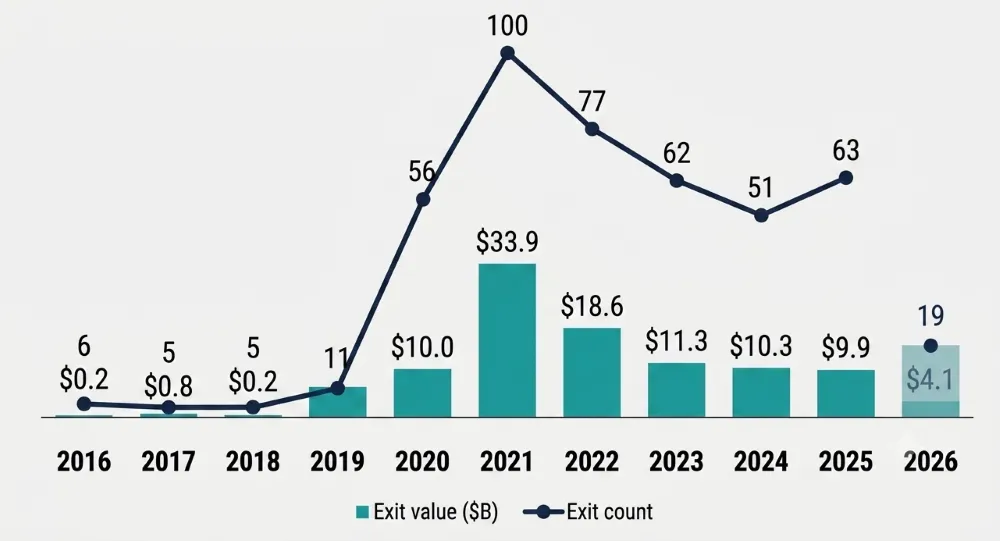
Source: PitchBook, data as of March 31, 2026
Strategic buyers continued paying premium valuations for established assets with proven commercial positions. Boston Scientific’s $14.5B acquisition of Penumbra and Danaher’s $9.9B acquisition of Masimo reinforced the willingness of large healthcare companies to use acquisitions as a tool for market expansion. Their goal of strengthening the portfolio is also non-negotiable. For investors, improving exit conditions enhances liquidity prospects and supports confidence in long-term value realization.
Read more: US VC in Transition: Valuations Reset, Returns Uneven
Capital Concentrates in Later-Stage Medtech Companies
While investors continued backing select early-stage opportunities, later-stage companies captured the largest share of medtech funding in 1Q26. According to J.P. Morgan, Series B and later-stage companies raised $2.1B across 50 deals in 1Q26, compared with only $0.4B across 29 Seed and Series A transactions. Larger financings also accounted for a significant share of funding activity, reinforcing the market’s preference for more mature assets.
This shift reflects a preference for businesses with stronger regulatory visibility, commercial traction, and more clearly defined growth pathways. As higher interest rates and longer diligence cycles continue influencing investment decisions, investors are increasingly prioritizing opportunities where risk-adjusted returns are easier to assess. While funding remains available across the ecosystem, access to capital is becoming increasingly tied to measurable progress and execution capability.
US Strategic Buyers Reposition Toward Higher-Growth Categories
US medtech M&A generated $36.5B in deal value during the first half of 2026, as strategic acquirers and PE firms continued repositioning portfolios toward higher-growth categories, as per PwC. Investment activity remained concentrated in cardiovascular technologies, neurostimulation, connected care platforms, and workflow platforms, reflecting sustained demand for technologies that strengthen market leadership and broaden care-delivery ecosystems.
Portfolio reshaping emerged as a defining feature of deal activity. Strategic buyers continued focusing on areas of competitive strength, while PE firms pursued carve-outs, take-privates, and operational value creation opportunities. As the medtech market becomes more selective, capital is increasingly flowing toward companies with differentiated technologies, commercial traction, and scalable growth potential.
About SG Analytics
SG Analytics (SGA) is a global leader in data-driven research and analytics, empowering Fortune 500 clients across BFSI, Technology, Media & Entertainment, and Healthcare. A trusted partner for lower middle market investment banks and private equity firms, SGA provides offshore analysts with seamless deal life cycle support. Our integrated back-office research ecosystem, including database access, design support, domain experts, and tech-enabled automation, helps clients win more mandates and execute deals with precision.
Founded in 2007, SGA is a Great Place to Work® certified firm with 1,600+ employees across the U.S., the UK, Switzerland, Poland, and India. Recognized by Gartner, Everest Group, and ISG and featured in the Deloitte Technology Fast 50 India 2023 and Financial Times APAC 2024 High Growth Companies, we continue to set industry benchmarks in data excellence.
Related Tags
Author

Steve Salvius
Head of Investment Banking & Private Equity
