Evergreen Funds Are Becoming the Default Gateway to Private Markets
Capital Markets



April, 2026
Evergreen funds are no longer a product innovation. They represent a structural response to the growing dominance of private wealth in capital formation. As scale, access, and liquidity design converge, these vehicles are redefining distribution and sustainability across private markets.
Private markets are undergoing a structural shift driven less by performance and more by changing capital sources. A growing share of investable wealth now sits with high-net-worth and mass affluent investors. At the same time, traditional drawdown structures remain difficult to access at scale. Evergreen funds are emerging as the industry’s response. They offer continuous entry, lower minimums, and periodic liquidity. Therefore, they are influencing how private markets are operating.
Read More: Consumer AI in 2026
Retail Capital Has Become a Core Market Driver
Retail investors seeking higher income and diversification now shape private markets. With traditional fixed income delivering lower yields, investors are reallocating toward private assets. They also seek to improve returns and gain exposure beyond public markets. This shift is occurring alongside the expansion of private markets. It supported over a quarter of M&A activity in 2025. It still holds approximately $2 trillion in dry powder, as per S&P Global.
Besides, the structural limitation of public markets is reinforcing this trend. A shrinking share of economic activity is captured by listed assets. That pushes investors toward private markets for exposure to innovation and growth. Additionally, evergreen funds address this gap by lowering entry barriers. Offering more accessible investment structures is their key feature. As a result, retail capital is no longer supplementary. Instead, it is becoming a key force shaping private market product design.
Read more: Global M&A Outlook 2026: Capital Repositions for a Structural Era
Evergreen Funds Have Become Central to Fundraising
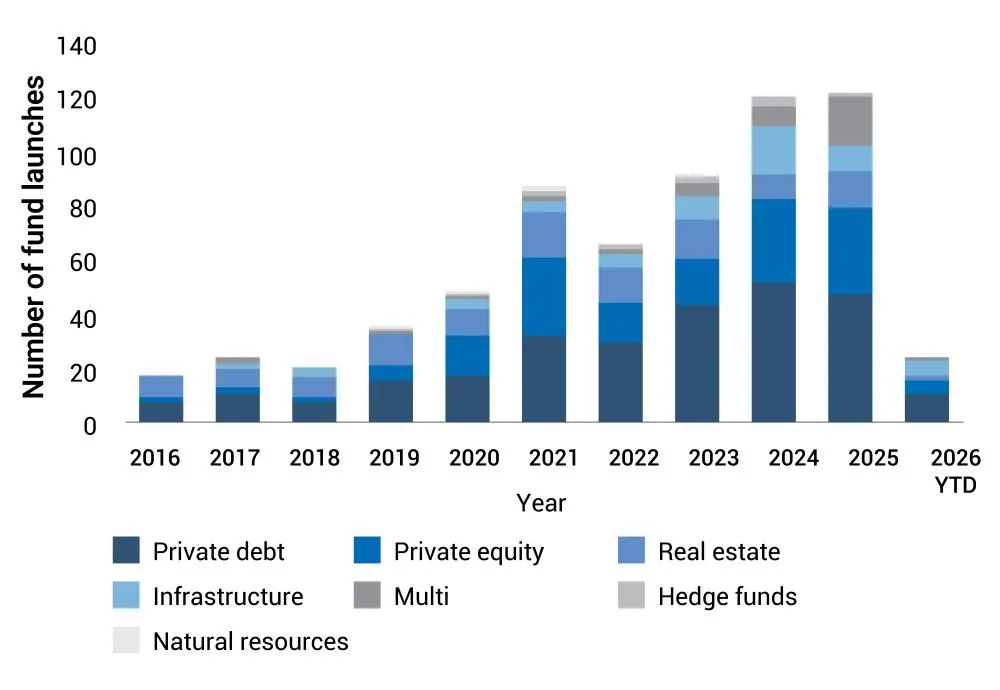
The surge in evergreen fund launches reflects a clear shift in GP fundraising strategies, driven by evolving investor demand. In 2025 alone, 123 evergreen funds were launched, including 49 in private credit and 32 in private equity, with another 30 vehicles introduced in the first two months of 2026, as per Preqin. These figures indicate that evergreen structures are being scaled across platforms rather than tested in limited cases, with adoption expanding across asset classes.
Figure 1: Evergreen Fund Launches Accelerate Across Asset Classes
Source: Preqin Pro, data as of February 2026
This momentum is even more pronounced over time. Between 2023 and 2025, 337 evergreen private capital funds were launched, exceeding the 299 funds introduced between 2016 and 2022. The pace of expansion signals a fundamental change in how managers approach fundraising, embedding evergreen vehicles into their core models to capture capital from the expanding wealth channel more efficiently.
Read more: Enterprise SaaS in 2026: From Growth to Discipline and AI-Led Monetization
Evergreen Funds Have Reached Institutional Scale
Evergreen funds have reached a level of scale that makes them institutionally relevant. By the end of 2025, total net assets in unlisted evergreen funds surpassed $530 billion in the US, representing an increase of more than $100 billion compared to the previous year, as per PitchBook. This rapid growth reflects strong investor adoption of the structure.
The composition of this growth indicates where investor demand is concentrated. Business development companies accounted for a significant share of total AUM, while alternative credit strategies led new launches across evergreen structures. This indicates that income-oriented strategies are playing a central role in scaling these vehicles within the wealth channel.
Read more: US IPO Outlook 2026: A Market Defined by Scale, Selectivity, and Execution
Liquidity Remains the Defining Constraint
Despite their appeal, semi-liquid evergreen funds face inherent challenges around liquidity, particularly during periods of market stress, volatility, and shifting investor sentiment. Recent market developments in credit-focused strategies have shown that redemptions can be prorated or restricted during periods of stress. These events highlight that liquidity in evergreen funds is conditional rather than guaranteed.
This creates a structural trade-off. While investors gain periodic access to capital, managers retain discretion to limit withdrawals to protect the fund. In volatile markets, this can lead to mismatches between investor expectations and actual liquidity. As a result, evergreen funds do not eliminate illiquidity but restructure it within controlled redemption frameworks, requiring a more disciplined understanding of liquidity risk.
Evergreen Funds Have Become the Default Entry Point
Evergreen funds are changing how private market exposure becomes available to investors by reducing barriers to entry and capital deployment. Unlike traditional funds, they allow continuous subscriptions, immediate exposure to diversified portfolios, and periodic liquidity. Minimum investment thresholds have also declined significantly, with some semi-liquid structures allowing entry at around $25,000, as per Morgan Stanley.
These funds also introduce a different capital cycle. Investor capital goes out immediately. Its reinvestment stays continuous. So, it creates a perpetual investment structure. This contrasts with traditional drawdown models, where capital is staged and returned over time. As a result, evergreen funds are increasingly becoming the primary entry point for wealth capital entering private markets.
Conclusion
Evergreen funds are reshaping private markets by aligning fund structures with a wealth-driven capital base. Their growth in fund launches and AUM reflects a structural shift in how capital raising and deployment evolve. While they improve access, they also introduce complexities around liquidity and investor expectations. For investors, evergreen funds offer a scalable pathway into private markets but require a disciplined approach to liquidity and long-term allocation.
About SG Analytics
SG Analytics (SGA) is a global leader in data-driven research and analytics, empowering Fortune 500 clients across BFSI, Technology, Media & Entertainment, and Healthcare. A trusted partner for lower middle market investment banks and private equity firms, SGA provides offshore analysts with seamless deal life cycle support. Our integrated back-office research ecosystem, including database access, design support, domain experts, and tech-enabled automation, helps clients win more mandates and execute deals with precision.
Founded in 2007, SGA is a Great Place to Work® certified firm with 1,600+ employees across the US, the UK, Switzerland, Poland, and India. Recognized by Gartner, Everest Group, and ISG and featured in the Deloitte Technology Fast 50 India 2023 and Financial Times APAC 2024 High Growth Companies, we continue to set industry benchmarks in data excellence.
Related Tags
Author

Steve Salvius
Head of Investment Banking & Private Equity
