Autonomy, Commercialization, and Capital Reshape the Defense Tech Landscape
Private Equity



June, 2026
Defense technology is rapidly evolving into a mainstream venture investment category with expanding investor interest. Record funding, broader adoption, and emerging exit pathways are strengthening market maturity.
Defense innovation is increasingly moving from experimentation to deployment. Advances in autonomous systems, next-generation industrial capabilities, and supporting technologies are creating new opportunities for venture-backed companies to scale. As investment activity accelerates across these segments, investors are placing greater emphasis on execution, adoption, and long-term value creation.
Defense Tech Evolves into a Scaled Venture Category
Defense technology has emerged as a meaningful segment of the global venture ecosystem. Related tech startups raised a record $19.8 billion across 262 deals in 1Q26. They were still trailing, with 12-month (TTM) funding reaching $64.9 billion, according to PitchBook. The sharp increase in capital deployment highlights growing investor participation. Besides, it reinforces the sector’s transition from an emerging theme to a standalone venture category.
Figure 1: Global Defense Tech VC Deal Activity
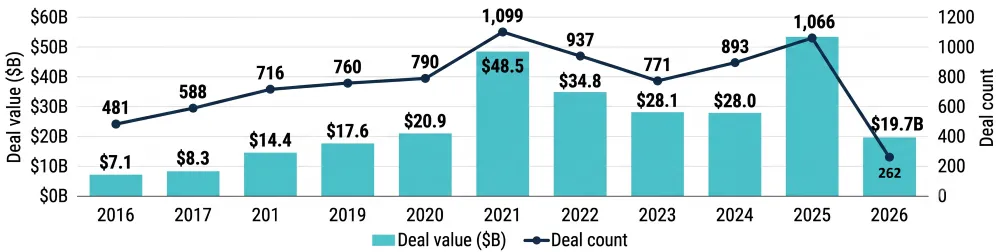
Source: PitchBook, data as of March 31, 2026
Investor conviction is also evident in the stage mix and valuation environment. Venture growth funding reached $9.3 billion during the quarter, while valuations expanded across nearly every stage. Seed and late-stage valuations increased significantly, and venture-growth valuations approached previous market peaks. Investors are increasingly underwriting defense technology companies as durable businesses capable of generating long-term growth.
Read more: Defense Tech VC: From Frontier to Core Allocation
Autonomous Systems Lead Defense Tech Investment Activity
Autonomous systems attracted the largest share of funding within the defense technology landscape. The segment generated approximately $16 billion in TTM investment across 212 deals, making it the sector’s largest category, as per PitchBook. It was also roughly 60% larger than the next-largest defense technology segment by deployed capital, underscoring the strong concentration of investor interest around autonomy-driven platforms.
Capital is increasingly flowing toward technologies that enable autonomous operations at scale. This momentum is creating immense opportunities across software, systems integration, and supporting infrastructure layers, particularly for businesses positioned at the center of these evolving ecosystems. As adoption expands, these enabling technologies could capture a disproportionate share of industry growth.
Quantum Sciences Develops Credible Exit Pathways for Investors
Quantum technology has historically faced questions around commercialization timelines and investor returns. That narrative began to shift in 1Q26 as the sector recorded its largest cluster of exits to date. The exit wave included Xanadu’s SPAC merger, Infleqtion’s SPAC merger, and Quantum Circuits’ $550 million acquisition, demonstrating growing investor appetite for the category and providing clearer evidence that venture-backed quantum businesses are beginning to establish viable pathways to scale.
Meaningful exit activity is important because it establishes clearer benchmarks for valuation and return potential. As capital-intensive technologies mature, credible exit pathways become increasingly important for attracting growth-stage funding. Recent transactions suggest quantum technologies are progressing beyond research-driven investment narratives and entering a phase where investors can more confidently evaluate commercial and financial outcomes.
Read more: Defense Spending: Is the World Buying Security or Fear?
Venture Funding Accelerates as M&A Activity Slows
Venture investment in defense technology continues to accelerate even as strategic consolidation moderates. According to S&P Global, defense-focused funding rounds reached approximately $29 billion in 2025, with companies such as Anduril, Shield AI, and Stoke Space securing some of the largest financings in the sector. Investor appetite remains strong for companies developing differentiated technologies with clear commercialization potential.
At the same time, M&A activity involving aerospace and defense targets has slowed from previous highs. With many large-scale industry combinations already completed, investors seek venture-backed innovators. They have become a source of future growth.
Against a backdrop of rising defense spending and geopolitical tensions, capital formation is occurring earlier in company lifecycles, creating new scaling opportunities.
Commercial Adoption Accelerates Across Defense Technologies
Several forces are accelerating the commercialization of defense technologies. Procurement modernization, stronger public market performance, greater participation from technology companies, and rising investor interest have collectively improved the operating environment for emerging businesses. Together, these developments are creating conditions that support faster scaling, broader adoption, and greater confidence in long-term business viability.
Autonomous systems illustrate this transition most clearly. Technologies once viewed as experimental are being deployed in real-world environments. These are also driving demand for new platforms. Thus, new software layers and supporting infrastructure have many takers. As highlighted in Bessemer’s defense technology roadmap, the next phase of innovation is likely to extend into AI-enabled workflows, advanced manufacturing, and industrial modernization.
Conclusion
Defense technology is increasingly exhibiting the characteristics of a mature venture category. Record funding levels, expanding exit activity, and improving deployment opportunities are creating a stronger foundation for long-term growth. While technological innovation remains important, future value creation will likely depend on a company’s ability to scale operations, commercialize solutions, and translate investor capital into sustainable market leadership.
About SG Analytics
SG Analytics (SGA) is a global leader in data-driven research and analytics, empowering Fortune 500 clients across BFSI, Technology, Media & Entertainment, and Healthcare. A trusted partner for lower middle market investment banks and private equity firms, SGA provides offshore analysts with seamless deal life cycle support. Our integrated back-office research ecosystem, including database access, design support, domain experts, and tech-enabled automation, helps clients win more mandates and execute deals with precision.
Founded in 2007, SGA is a Great Place to Work® certified firm with 1,600+ employees across the U.S., the UK, Switzerland, Poland, and India. Recognized by Gartner, Everest Group, and ISG and featured in the Deloitte Technology Fast 50 India 2023 and Financial Times APAC 2024 High Growth Companies, we continue to set industry benchmarks in data excellence.
Related Tags
Author

Steve Salvius
Head of Investment Banking & Private Equity
